


In the rapidly evolving landscape of speech-to-text technology, understanding the unique strengths of Deepgram and Contextli can empower professionals to choose the right tool for their specific communication needs. Deepgram excels in raw transcription accuracy and speed, while Contextli revolutionizes professional communication with its context-aware processing.
Summary
Deepgram provides highly accurate and fast speech-to-text transcription, ideal for large-scale audio processing and real-time applications. In contrast, Contextli focuses on transforming spoken input into context-appropriate written text for various professional communication scenarios, such as emails, messages, and notes, leveraging its unique 'Modes'. This article offers a detailed comparison to help professionals decide between Deepgram vs. Contextli based on their specific requirements.
Understanding Speech-to-Text Technology
Speech-to-text technology, also known as automatic speech recognition (ASR), converts spoken language into written text. This technology has evolved significantly over the years, moving from rudimentary dictation to sophisticated systems capable of handling complex linguistic nuances. For professionals, speech-to-text software has become an invaluable tool for enhancing productivity, streamlining workflows, and improving accessibility. Whether for transcribing meetings, dictating documents, or quickly drafting communications, these tools save considerable time and effort. Professionals increasingly rely on speech recognition software for Windows and other operating systems to manage their daily tasks efficiently. To explore voice typing tools, you can explore voice typing tools.
Overview of Deepgram
Deepgram is a leading provider of advanced speech-to-text solutions, primarily known for its high accuracy, low latency, and scalability. Its technology is built on deep learning models, allowing it to process vast amounts of audio data with remarkable precision. Deepgram's offerings are particularly well-suited for developers and enterprises that require robust, customizable voice-to-text APIs for integration into their applications and services.
Key Features of Deepgram
Deepgram stands out with several powerful features designed for demanding professional environments. Its core strength lies in its highly accurate transcription, powered by advanced AI models like Nova-3. Deepgram has processed over 50,000 years' worth of audio recordings, transcribing over one trillion words with industry-leading accuracy, consistently reducing the need for costly manual corrections. This impressive capability is crucial for applications where transcription errors can have significant consequences.
Another key feature is its real-time transcription, which offers minimal latency, making it suitable for live captioning, voice assistants, and interactive voice response (IVR) systems. Deepgram also provides extensive language support and speaker diarization, which identifies and separates different speakers in an audio stream. Customization options, including custom vocabulary and acoustic models, allow users to fine-tune the transcription engine for specific terminology or challenging audio environments. Deepgram achieved a 7.6% Word Error Rate (WER) compared to Google Cloud Speech-to-Text's 13.1% WER in real-world environments with background noise, accents, and multiple speakers. This statistic underscores its superior performance in diverse and challenging audio conditions.
Use Cases for Deepgram
Professionals leverage Deepgram for a wide array of applications where precise and rapid transcription is paramount. In contact centers, Deepgram helps analyze customer interactions, identify trends, and improve agent performance by transcribing calls accurately. For media companies, it facilitates the creation of captions and subtitles for video content, ensuring accessibility and discoverability. Developers integrate Deepgram's voice to text API into custom applications for various purposes, from transcribing medical dictations to powering voice-controlled interfaces. CallTrackingMetrics, a provider of call tracking and automation software, improved transcription accuracy to over 90% and reduced overall costs by integrating Deepgram's AI Speech Platform. This real-world example demonstrates the tangible benefits businesses can gain from Deepgram's robust technology.
Overview of Contextli
Contextli is a desktop application designed specifically for professionals who need to communicate effectively across multiple platforms. Unlike traditional dictation tools that provide raw transcription, Contextli introduces "Modes" - context-aware processing profiles that automatically adapt speech input to the appropriate output format, tone, and structure. This innovative approach addresses the common problem of cognitive load and friction experienced when professionals must constantly switch their writing style to suit different communication channels. Contextli excels in appropriateness and clarity, ensuring your spoken words transform into the right kind of text for each specific context. To learn more about Contextli's features, you can check out Learn more about Contextli's features.
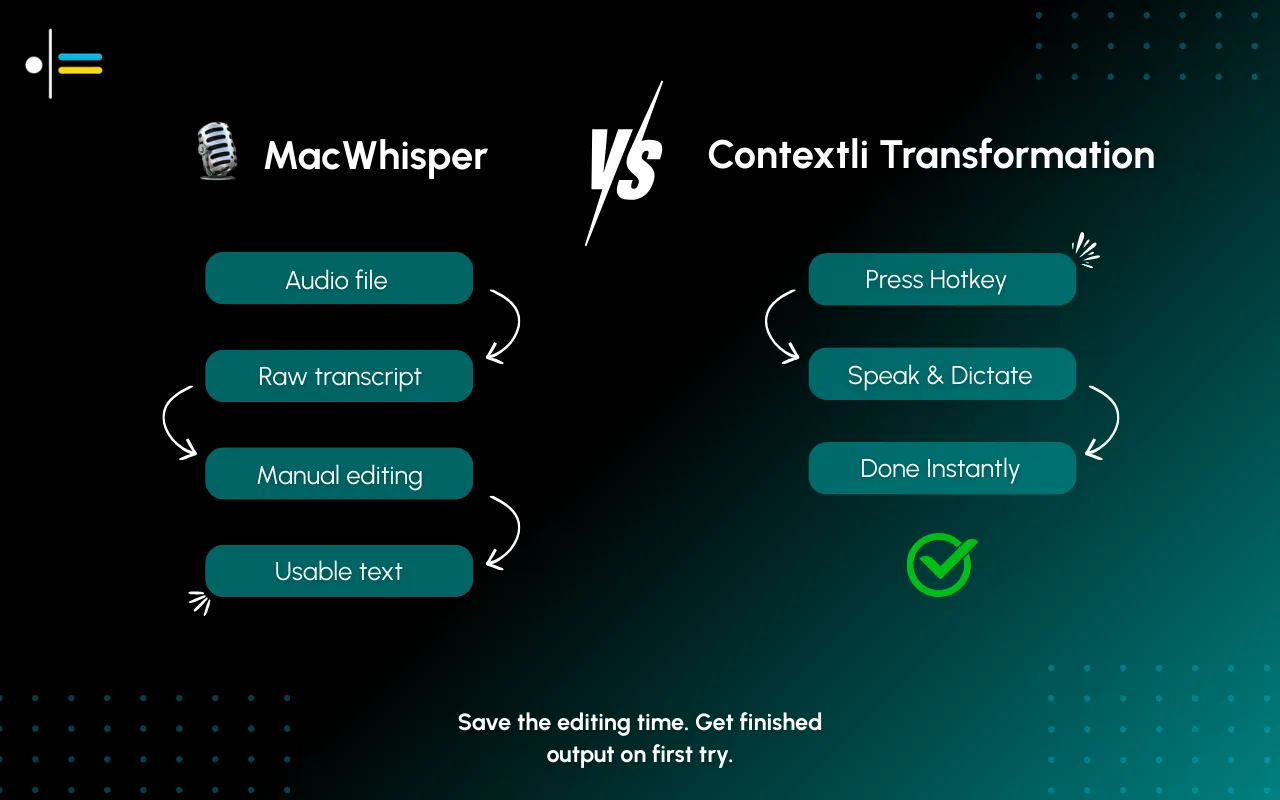
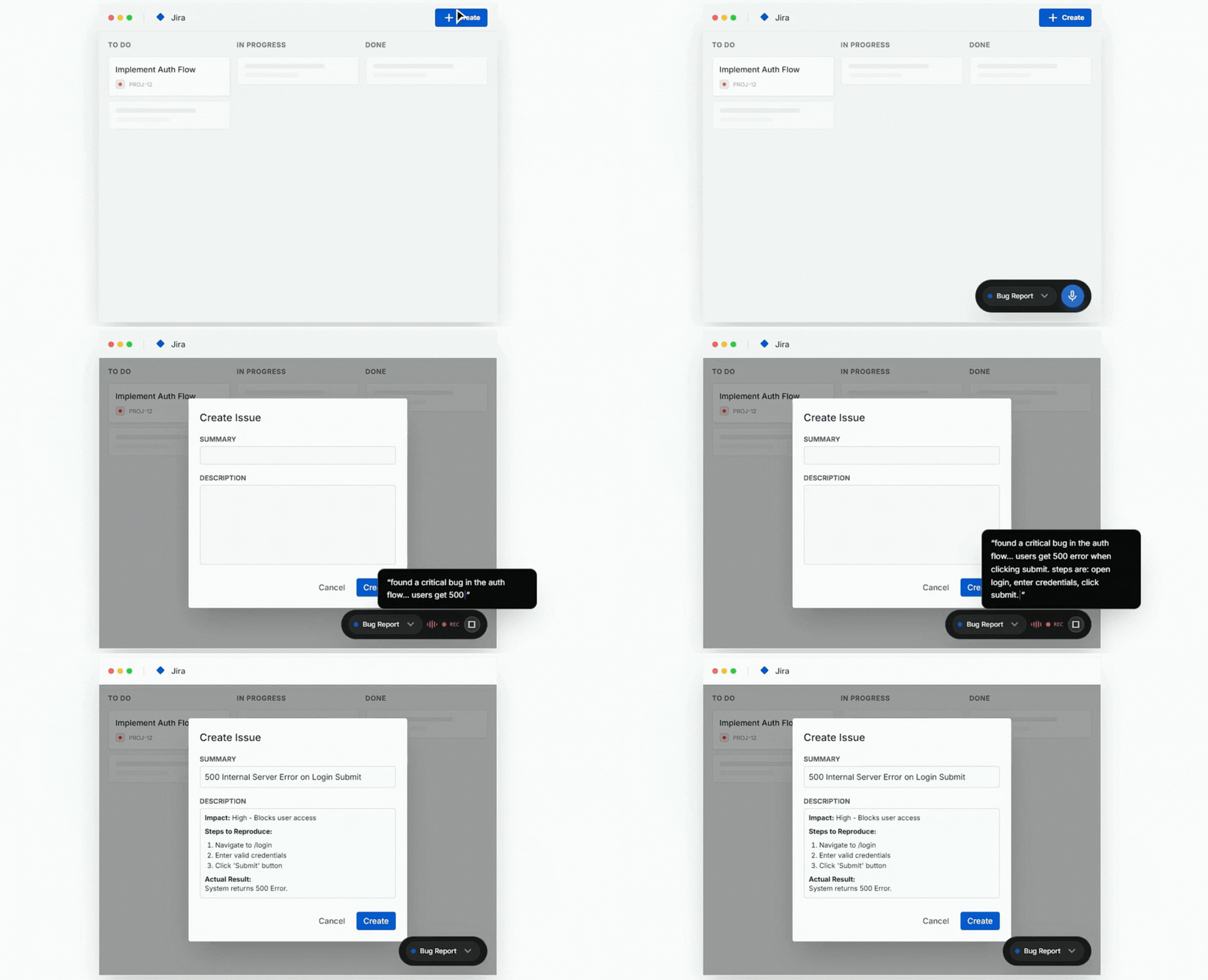
Modes of Contextli
Contextli's distinctiveness lies in its unique 'Modes', which are tailored to specific professional communication needs. These modes transform spoken input into polished, context-appropriate text, significantly reducing editing time and mental effort.

- Email Mode: This mode processes speech into a professional, neutral tone with proper email structure, including greetings, clear paragraphs, and appropriate closings. It's designed for formal or semi-formal correspondence, ensuring your emails are always polished and coherent.
- Messaging Mode: Ideal for platforms like Slack or WhatsApp, this mode generates conversational and concise text. It strips away unnecessary formality, focusing on brevity and directness, making your instant messages natural and efficient.
- Notes Mode: When dictating personal notes or meeting summaries, this mode converts speech into organized bullet points. This structure helps in rapidly capturing key information and ensures readability and easy recall.
- LinkedIn Mode: For professional social media posts, this mode crafts text with a professional-casual tone. It's designed to be engaging and informative, suitable for networking and personal branding on platforms like LinkedIn.
- Marketing Copy Mode: This mode focuses on benefit-driven, persuasive writing, perfect for drafting ad copy, product descriptions, or promotional content. It helps articulate value propositions clearly and compellingly.
- General Dictation: For standard transcription needs, this mode provides clean, accurate text that preserves the original meaning without applying specific contextual formatting, serving as a versatile foundation for various written tasks.
Use Cases for Contextli
Contextli is invaluable for professionals who frequently switch between different communication channels and need their output to be consistently appropriate. Founders and entrepreneurs can quickly draft emails to investors, casual messages to their team, and structured notes from meetings, all from a single spoken input. Consultants and advisors can maintain appropriate client-facing communication, effortlessly shifting between formal email updates and more relaxed Slack messages. Knowledge workers and heavy email and messaging users benefit from the reduced cognitive load, as they no longer need to mentally reformat their thoughts for each platform. For content creators, Contextli streamlines the process of generating LinkedIn posts, marketing copy, and internal notes, each with the correct tone and structure. It's also highly beneficial for those who use voice typing in Google Docs, allowing them to dictate once and then apply Contextli's modes to adapt the content for different destinations.
Comparative Analysis: Deepgram vs. Contextli
When evaluating Deepgram vs. Contextli, it's crucial to understand their fundamental differences in purpose and functionality. Deepgram is primarily a voice to text API focused on highly accurate, low-latency transcription of spoken audio into raw text. Its strength lies in its ability to process vast amounts of audio data precisely, making it an excellent choice for developers building applications that require real-time transcription or large-scale audio analysis. Deepgram's advanced models are designed to handle complex audio environments, ensuring high fidelity in transcription regardless of background noise or multiple speakers.
Contextli, on the other hand, is a desktop application that takes raw speech-to-text output a step further. While it relies on accurate speech recognition, its core value proposition is the intelligent transformation of that raw text into context-appropriate written content. Contextli is not just about what you say, but how it should be written for a specific audience and platform. It addresses the nuanced needs of professionals who require their communication to be polished, structured, and tonally correct across emails, messages, notes, and social media posts.
| Feature / Aspect | Deepgram | Contextli |
|---|---|---|
| Primary Function | High-accuracy, low-latency raw transcription | Context-aware text generation from speech |
| Target User | Developers, enterprises, data scientists | Professionals, knowledge workers, founders, consultants (40+ age group) |
| Output | Raw, unformatted text | Contextually formatted text (e.g., professional email, concise message, bulleted notes) |
| Key Differentiator | Industry-leading accuracy, speed, scalability | Unique 'Modes' for different communication contexts |
| Integration | API-first for custom applications | Desktop application, integrates with various writing platforms (e.g., Google Docs, Slack) |
| Focus | Technical accuracy of transcription | Appropriateness, clarity, and efficiency of professional communication |
| Use Cases | Call analytics, voice assistants, media captioning | Email drafting, messaging, note-taking, social media posts, marketing copy |
| Cognitive Load | Reduces manual transcription efforts | Significantly reduces mental effort in adapting writing style for different platforms |
The choice between Deepgram and Contextli depends on a professional's primary need. If the goal is to integrate highly accurate deepgram speech to text capabilities into a larger system or application, Deepgram is the clear choice. If the goal is to streamline daily professional communication, ensuring that spoken words are automatically transformed into correctly formatted and toned text for various contexts, then Contextli offers a unique and highly beneficial solution. Compare Contextli with other voice-to-text software to understand its broader market position.
User Experience
User experience with Deepgram is largely centered around its API and developer tools. Developers appreciate its well-documented APIs, robust SDKs, and the flexibility to integrate high-quality speech to text software into their custom applications. The focus is on technical performance, ease of integration, and the ability to customize models for specific needs. Users who interact with applications powered by Deepgram benefit from highly accurate and fast transcriptions, which contribute to a seamless and efficient experience within those applications. Deepgram holds an 18.5% mindshare in Speech-To-Text Services, with 81% of users willing to recommend the solution, indicating strong satisfaction among its user base.
Contextli's user experience, on the other hand, is designed for end-users-professionals who need to write effectively across different contexts. Its desktop application interface is intuitive, allowing users to easily switch between 'Modes' and dictate their thoughts. The primary benefit for Contextli users is the dramatic reduction in mental effort required to tailor their communication. Instead of manually editing raw transcriptions to fit an email, a Slack message, or a LinkedIn post, Contextli automatically handles these transformations. This leads to a more predictable and professional output, saving time and reducing the cognitive load associated with context-switching. For professionals who frequently use voice typing in Google Docs or other writing platforms, Contextli enhances their workflow by providing ready-to-send text directly from their speech.
Conclusion: Which Tool is Right for You?
Choosing between Deepgram and Contextli ultimately depends on your specific professional needs and objectives.
If your primary requirement is high-accuracy, low-latency raw speech-to-text transcription for integration into complex applications, large-scale audio processing, or real-time services, Deepgram is the superior choice. Its robust voice to text API, advanced AI models, and proven accuracy make it ideal for developers and enterprises building sophisticated voice-enabled solutions. Deepgram is for those who need the foundational technology to accurately convert spoken words into text, often as a component of a larger system.
However, if you are a professional who frequently communicates across diverse platforms-emails, messaging apps, social media, and notes-and struggles with the cognitive load of adapting your writing style for each context, then Contextli is designed specifically for you. Contextli's unique 'Modes' automatically transform your spoken input into polished, context-appropriate text, ensuring that your communication is always clear, professional, and perfectly aligned with the platform's requirements. It reduces editing time, enhances communication efficiency, and provides predictability in your professional output. For those who value simplicity, predictability, and professional output in their daily communication, Contextli offers a transformative solution. This speech to text software simplifies the act of writing, allowing you to speak once and write appropriately everywhere.
FAQ
What are the main differences between Deepgram and Contextli?
Deepgram is primarily a high-accuracy, low-latency voice to text API designed for developers and enterprises to integrate raw transcription into their applications. Contextli is a desktop application for professionals that transforms spoken input into context-aware, polished text for various communication formats, such as emails, messages, and notes, using its unique 'Modes'.
Can Deepgram be used for everyday professional dictation?
While Deepgram provides highly accurate transcription, it is an API-first solution, meaning it requires technical integration into other applications. For direct, everyday professional dictation without custom development, other dedicated speech recognition software for Windows or desktop dictation tools might be more directly applicable, or solutions like Contextli that build upon transcription.
How do Contextli's 'Modes' improve professional communication?
Contextli's 'Modes' automatically adapt your spoken words into the appropriate tone, structure, and formatting for different communication contexts (e.g., Email Mode for professional emails, Messaging Mode for concise chats, Notes Mode for bullet points). This significantly reduces the mental effort and editing time required for professionals who communicate across various platforms.

