

Weekly Reflection TemplateAug 19, 2026
Weekly Review Template: Run Your Review in 15 Minutes
A weekly review template you can run in 15 minutes every Sunday. Six prompts, a scoring table, and a faster way to capture it by voice.
 Junaid Khalid
A 2026 voice-to-text guide for marketing specialists writing landing-page copy, social posts, email subject lines, and LinkedIn updates in a consistent brand voice across channels.
A marketing specialist writes more short-form copy in a day than almost any other role: a landing-page headline, three subject-line variations, a Slack-to-LinkedIn rewrite for the founder, two ad headlines, an internal status update, then back to the landing page for the second variant. The work is fast, channel-specific, and brand-voiced. The bottleneck is not the words. The bottleneck is the constant switching between voices and formats.
Voice-to-text should fit marketing work better than it does. The problem is that most dictation tools were built for one output style: turn speech into text, hand you a wall of unpunctuated transcript, you reshape it for whichever channel you needed. A marketer running six channels a day cannot afford to reshape every dictation manually. That undoes the time saving.
This guide covers what marketing specialists should look for in a voice-to-text tool in 2026, how Contextli's Marketing Copy Mode and LinkedIn Mode fit a marketer's day, and where the trade-offs sit against ChatGPT voice and the other named tools.
A marketing specialist's day is not one long writing session. It is dozens of short ones, in different formats, for different audiences. The Slack message to the design team needs to be short, casual, and direct. The LinkedIn post written under the founder's name needs to sound like the founder, not like the marketer. The landing-page headline needs to be tight, benefit-led, and on-brand. The ad copy needs to compress the same value proposition into 90 characters. The internal weekly update needs to be readable in 60 seconds.
A generic voice-to-text tool gives the marketer the same output style for all of those. The marketer dictates "we just launched the new pricing page, conversion is up 18 percent week over week, the team should celebrate," and the tool transcribes it word for word. That output is wrong for every single channel above. The Slack message would not include "we just launched." The LinkedIn post would not start with a stat without a hook. The internal update would not use first-person plural that way. The marketer has to rewrite all six versions by hand.
A context-aware voice-to-text tool does the opposite. The marketer says the same sentence and the tool produces the right output for whichever Mode is active. In Messaging Mode, two short Slack-style lines. In LinkedIn Mode, a tight three-paragraph post that opens with the result and reads in the founder's voice. In Marketing Copy Mode trained on the brand's past landing pages, a headline plus subhead that match the existing site's tone. The marketer reviews, tweaks one word, ships.
The criteria are not the same as for a single founder dictating an investor update. The differences matter.
Brand-voice consistency across all the copy a marketer writes. A marketing team has spent years building a voice. A new tool should preserve that voice automatically, not require the marketer to add "in our brand voice" to every prompt. The voice should be configured once.
Per-channel adaptation, not one-style-fits-all. A LinkedIn post is not a Slack message is not a landing-page headline is not a cold email. Each channel has its own structure. A tool that produces the same output style for all of them shifts the formatting work back to the marketer.
Speed-to-first-character. Marketers context-switch constantly. A tool that takes 3 clicks to start dictating is too slow. Global hotkeys that work into the focused app, including the browser tab, are non-negotiable.
Output that is shippable, not a first draft. The output should not need to be rewritten end to end. One or two edits, max. If the marketer has to rewrite from scratch, the dictation tool was useless.
Cross-platform parity. Marketing teams are on mixed hardware. A Mac-only tool fails for a team where the founder is on Windows.
Privacy options when needed. Most marketing copy is not sensitive, but the marketer who is dictating drafts of a positioning pivot, an unannounced product launch, or a sensitive comms response does not want that audio leaving their machine. The option to run locally matters even if the marketer does not use it every day.
The setup that pays for itself the first week is short. The marketer customizes three Modes: Marketing Copy Mode for landing-page and ad work, LinkedIn Mode for personal-brand or founder-voice posts, and Messaging Mode for internal Slack and DMs to the design or product team.
The base Modes are the starting point. The actual win comes from making them yours.
Every Mode can be customized. Feed Marketing Copy Mode three or four examples of how your team actually writes landing-page copy, your headline style, your subhead pattern, your preferred CTA structure, and from then on every dictated headline matches that voice. You can give it specific instructions too: "always use UK spellings," "never start a headline with a question," "the subhead must include a number." Same for LinkedIn Mode, same for Messaging Mode, same for any Mode you customize.
For LinkedIn Mode specifically, the workflow that lands hardest: paste in 5 of the founder's best-performing past posts. Mode learns the cadence, the line-break habit, the opener-to-payoff structure. From then on, when the marketer dictates "make the case that our 18 percent conversion lift came from cutting the form fields, not from the new design," LinkedIn Mode produces a post that reads like the founder wrote it. The marketer reviews, sends to the founder for one-line approval, ships.
If the marketer turns on screen-awareness (off by default, the marketer controls it), Contextli can also see what is open on screen. Looking at the analytics dashboard while dictating the social post means the post can pull the exact numbers from the dashboard without the marketer re-stating them.
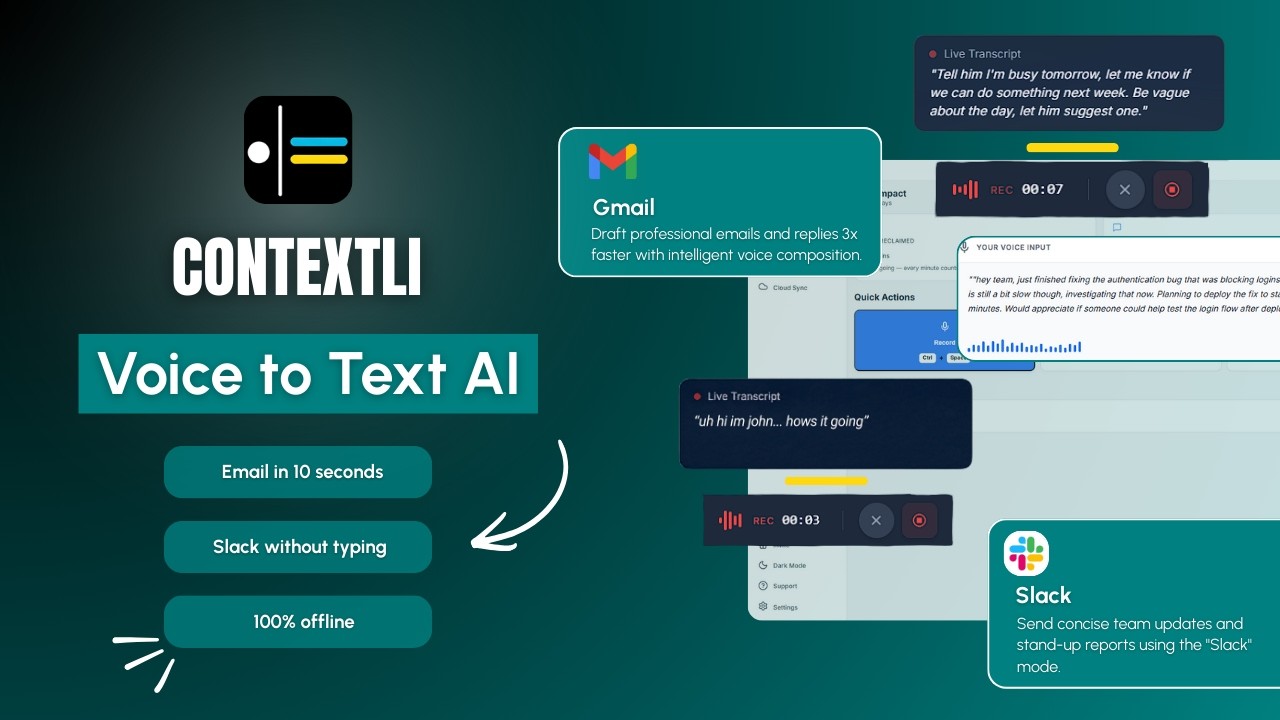
The video below walks through how the Modes work in practice.
A B2B SaaS marketing specialist opens their laptop at 8:30 a.m. The week's queue: a new landing page for the pricing change going live Thursday, three social posts to support it (one LinkedIn, one X, one company-page LinkedIn), an email to the existing-customer list explaining the pricing change, a Slack update to the design team flagging two visual tweaks, and the founder's personal LinkedIn post about why the pricing changed.
The marketer has already configured three Modes: Marketing Copy Mode trained on the brand's past 8 landing pages, LinkedIn Mode trained on the founder's last 12 high-performing posts, Messaging Mode for internal Slack.
They open the landing-page draft in the CMS. Marketing Copy Mode is active. They hit the global hotkey and dictate: "lead with the new starting price, $39 a month, explain the value drop is because we removed the seat-cap and added unlimited integrations, end with a soft CTA to compare plans." Contextli produces a hero headline, a subhead, and a 2-paragraph value-prop block in the brand's voice. The marketer edits one phrase, ships the draft to design.
They switch to LinkedIn Mode for the founder's post. They dictate: "tell the story of why we cut prices, lead with the customer feedback that drove the change, acknowledge that pricing is the hardest call a startup makes, end on the change matters more than the announcement." LinkedIn Mode produces a 4-paragraph post that opens with a one-line hook, walks through the customer feedback, lands the line about pricing being the hardest call, and closes on the change-not-announcement frame, in the founder's cadence. The marketer sends it to the founder. The founder edits one word, posts.
They switch to Messaging Mode for the Slack update to design: two lines, no greeting, the two tweaks called out by element name. Sent in 15 seconds.
Total elapsed time on the landing-page hero, the founder's LinkedIn post, and the design Slack: about 18 minutes. Typing the same set without Contextli would have taken closer to 75 minutes, mostly in the LinkedIn post where matching the founder's voice from a blank cursor is slow work.
The table below shows how the leading voice-to-text tools handle the things marketing teams care about: brand voice, per-channel adaptation, integration with the marketer's existing apps, and privacy options.
| Capability | Contextli | ChatGPT voice | Wispr Flow | Copy.ai |
|---|---|---|---|---|
| Voice input | Yes | Yes | Yes | No (text only) |
| Per-Mode output style | Yes | No (one chat output) | No (raw transcription + edits) | No |
| Brand voice trained by example | Yes | Partial (Custom Instructions) | No | Partial (brand voice setup) |
| LinkedIn-tuned Mode | Yes | No | No | No |
| Local model option | Yes | No | No | No |
| BYOK option | Yes | No | No | No |
| System-level into any app | Yes | No (lives in ChatGPT) | Yes | No (web app) |
| Pricing (Individual, monthly) | Free + paid | $20 (Plus) | $15 | $36 (Pro) |
The wedge for marketers is not speed. ChatGPT voice and Wispr Flow are both fast. The wedge is that ChatGPT voice gives you one output style (a chat reply), and you have to copy-paste the result into wherever the copy actually needs to live. Wispr Flow transcribes verbatim and you do the formatting work. Copy.ai has brand-voice features but no voice input. Contextli is the only one that combines voice input with per-channel Modes trained on the brand's past writing.
The table below summarizes the comparison in one image.

A marketing manager evaluating a voice-to-text tool for the team is not just picking the fastest one. They are picking a tool that produces shippable output, preserves brand voice, and works inside whatever stack the team already runs (a CMS, an email tool, LinkedIn, Slack, Figma comments). For quick one-off email edits outside a dictation flow, our free email rewriter cleans up a draft in seconds.
ChatGPT voice does not write into those apps. It writes inside ChatGPT. The marketer copy-pastes the result into the CMS, the LinkedIn box, the Slack thread. That is two extra steps per piece of copy. Multiplied across 30 pieces of copy a week, that is roughly an hour of pure copy-paste work.
Wispr Flow writes into the focused app, which is faster, but the output is verbatim transcription. The marketer still rewrites each piece for the channel's tone. That is also roughly an hour a week of rewriting work.
Contextli writes into the focused app AND produces channel-appropriate output. The marketer's hour back per week is the lift. Multiplied across a 5-person marketing team, that is 5 hours a week, 250 hours a year. The pricing math at team scale stays favorable, since Contextli's free tier gives 100 credits per user per month, no credit card required.
For related reading on the foundation behind context-aware Modes, see our pillar guide on context-aware speech-to-text for professionals. For a head-to-head against the most-named generalist alternative, see ChatGPT vs Contextli. For where Contextli sits in the broader voice AI writing tool landscape, see our roundup of AI writing tools and voice-to-text software.
A reasonable benchmark for a B2B SaaS marketer in 2026 is 15 to 30 short pieces of copy a day: landing-page sections, subject lines, ad headlines, internal updates, social posts. With a per-Mode trained dictation tool, the per-piece time drops from 4 to 6 minutes (typing from a blank cursor) to 60 to 90 seconds (dictate, review, ship). The savings compound on the high-volume days.
It can produce the hero block, the subhead, and the first value-prop section reliably in one dictation. Long landing pages with multiple feature blocks usually work better as 3 to 5 separate dictations, each scoped to one section. The Mode keeps the brand voice consistent across all of them because the configured examples persist across dictations.
If you train LinkedIn Mode on 5 to 10 of the founder's past posts, the output reads like the founder. If you skip the training step and use the default Mode, the output reads like a generic professional LinkedIn post. The training step is what makes the difference. It takes about 10 minutes to set up and the founder usually only has to edit one line per dictated post.
Not exactly. Copy.ai and Jasper are AI copywriting tools. You give them a brief, they generate copy. Contextli is a dictation tool: you supply the idea by voice, it shapes the words. The two can coexist. A marketer might use Copy.ai for cold-start variations and Contextli for the day-to-day high-frequency copy where they already know what they want to say but typing is the bottleneck.
No. Contextli is a system-level dictation app that types into the focused window. For LinkedIn, that means the marketer opens LinkedIn's compose box and dictates into it. There is no API integration that posts on the marketer's behalf. That separation keeps the marketer in control of what actually ships.
For sensitive drafts (unannounced pricing changes, comms responses to outages, positioning pivots), the marketer can switch to Contextli's local model mode. Transcription and processing run on the marketer's machine. Internet can be off. The draft never leaves the laptop. This is opt-in; the marketer chooses which dictations need it.
Indirectly. The Mode is not channel-aware enough to enforce X's 280-character limit or LinkedIn's 3,000-character limit automatically, but if the marketer says "give me a 90-character headline for a Google Ad," the output respects the constraint. For systematic ad-character-limit work, the marketer should add the limit to the Mode's custom instructions ("always under 90 characters when I say it's for an ad").
The Modes are configured per-user today. The recommended pattern: one senior marketer or the manager writes a sharable "brand voice template" (the list of past landing pages and the written instructions) that every team member pastes into their own Mode settings. Team-level Mode sync is on the roadmap; for now, the template approach works.
If you run marketing for a B2B SaaS or services business and want to see whether voice-to-text actually saves your team time, the fastest way to find out is to set up Marketing Copy Mode with 3 to 5 of your past landing-page sections and try it for a week. The free tier (100 credits per month per user, no credit card required) is enough to test against a real week of copy work.
See how marketing teams use Contextli on the use-cases page, or download Contextli at contextli.com/download to set up your first Mode.

Junaid Khalid
Founder & CEO
Founder and solopreneur writing about how modern businesses run leaner and faster with AI. I build software that turns everyday work, from capturing thoughts to writing and staying organized, into something effortless, and I share what I learn along the way.
A weekly review template you can run in 15 minutes every Sunday. Six prompts, a scoring table, and a faster way to capture it by voice.
Junaid KhalidA vet visit notes template that captures the diagnosis, dosing, and follow-up before you leave the exam room. Speak it into your notes instead of typing.
Junaid KhalidCounseling progress notes software that writes your notes by voice and keeps client data on your own machine, so counselors finish notes the same day.
Junaid Khalid