Voice recognition technology is a sophisticated field that converts spoken language into written text, fundamentally transforming how professionals interact with digital platforms. This advanced capability, often referred to as speech-to-text technology, allows individuals to dictate emails, craft messages, and take notes with unprecedented efficiency. For professionals navigating diverse communication needs, understanding the mechanics and applications of this technology is key to leveraging its full potential, including tools like voice recognition.
Summary
Voice recognition technology identifies and translates spoken language into text, enhancing professional communication efficiency. It works through acoustic modeling, phonetic analysis, and language modeling, converting sound waves into text. Applications range from dictation to smart assistants, with specialized tools like Contextli offering context-aware "Modes" for tailored output, such as 'Email Mode' for formal correspondence or 'Messaging Mode' for concise team communication. This technology significantly boosts productivity, reduces cognitive load, and improves accessibility, despite challenges like accuracy and privacy concerns. The global voice recognition market is projected to reach USD 61.71 billion by 2031, reflecting its growing importance for professionals seeking streamlined, appropriate, and clear communication.

Understanding Voice Recognition Technology
Voice recognition technology, often used interchangeably with speech recognition technology, is a field of computer science that enables the identification and translation of spoken language into text. This capability has moved from science fiction to an indispensable tool in modern professional life, offering significant advantages in productivity and accessibility. For professionals, the ability to convert thoughts directly into written words without typing can dramatically streamline workflows, particularly for heavy email and messaging users.
The significance of voice recognition technology in today's workplace cannot be overstated. It empowers busy professionals, founders, consultants, and knowledge workers to communicate more efficiently across multiple platforms. Whether it's drafting a formal email, sending a quick Slack message, or compiling detailed notes, voice to text technology helps bridge the gap between spoken thought and written output. This technology is not merely about speed; it's about enabling a seamless transition between different communication styles and contexts.
How Voice Recognition Works
The core process behind voice recognition involves several intricate steps that transform raw audio into intelligible text. When a user speaks, the system captures the sound waves and begins a multi-stage analysis. This complex sequence allows the technology to accurately interpret human speech, even with varying accents, tones, and speaking speeds.
Here's a breakdown of how voice recognition technology works:
- Analog-to-Digital Conversion: The microphone captures sound waves, which are analog signals. These are then converted into digital signals that a computer can process. This involves sampling the audio at regular intervals and quantifying the amplitude of the sound.
- Signal Pre-processing: The digital audio signal undergoes pre-processing to clean it up. This includes noise reduction to filter out background sounds, normalization to adjust volume levels, and segmentation to break the audio into smaller, manageable units, often phonemes or words.
- Feature Extraction: From the cleaned audio segments, specific acoustic features are extracted. These features represent the unique characteristics of speech sounds, such as pitch, frequency, and intensity. Mel-frequency cepstral coefficients (MFCCs) are commonly used for this purpose, providing a compact representation of the sound.
- Acoustic Modeling: The extracted features are then compared against an acoustic model. This model is a statistical representation of the different sounds (phonemes) in a language and how they are pronounced. It has been trained on vast amounts of speech data, allowing it to predict the most likely sequence of phonemes given the acoustic input. Hidden Markov Models (HMMs) are a traditional technique used here, though deep neural networks (DNNs) are increasingly prevalent for their superior accuracy.
- Phonetic Analysis: The system uses the acoustic model to identify the individual phonetic units (phonemes) present in the speech. This step attempts to determine the most probable phoneme sequence.
- Language Modeling: Once a sequence of phonemes is generated, a language model comes into play. This model understands the grammatical structure, vocabulary, and common phrases of a language. It helps in disambiguating similar-sounding words and predicting the most likely word sequence based on context and probability, significantly improving accuracy. For example, it helps distinguish "recognize speech" from "wreck a nice beach."
- Text Output: Finally, the system combines the phonetic and language model outputs to generate the most probable sequence of words, which is then presented as written text. Advanced systems also incorporate punctuation and formatting rules at this stage.
Key Components of Voice Recognition Systems
Behind every functional voice recognition system are several critical components that work in concert to achieve accurate speech-to-text conversion. These elements are constantly being refined through advancements in artificial intelligence and machine learning.
- Microphone and Audio Input: The quality of the microphone and the audio input is fundamental. A clear audio signal minimizes noise and improves the accuracy of subsequent processing stages.
- Acoustic Models: These models are statistical representations of the sounds that make up a language. They are trained on large datasets of spoken words and their corresponding phonetic transcriptions, learning to associate specific acoustic patterns with particular phonemes or sounds.
- Pronunciation Dictionaries (Lexicons): A lexicon maps phonetic sequences to actual words. It contains a list of words and their corresponding phonetic spellings, helping the system to convert identified phonemes into recognizable words.
- Language Models: These statistical models predict the likelihood of a sequence of words occurring together. They are crucial for improving accuracy by understanding grammar, syntax, and context, enabling the system to choose the most probable word sequence from several phonetically similar options.
- Decoding Algorithms: These algorithms search through the vast number of possible word sequences to find the one that best matches the acoustic input, guided by both the acoustic and language models. Modern decoders often leverage neural networks for enhanced performance.
- User Interface: This component allows users to interact with the voice recognition software, providing feedback, corrections, and control over features. For professionals, an intuitive interface is vital for seamless integration into daily tasks. In 2024, software-centric architectures accounted for 70.7% of the voice recognition market value, with cloud deployment representing 62.1% of implementations. This highlights the reliance on robust software and cloud-based processing for efficient voice recognition.
Applications of Voice Recognition Technology in Professional Settings
The utility of voice recognition technology extends across a broad spectrum of professional activities, fundamentally altering how tasks are performed and communication is managed. For professionals, the benefits translate into enhanced efficiency, reduced manual effort, and improved accessibility.

- Dictation and Documentation: One of the most common applications is dictating documents, emails, and reports. This is particularly valuable for lawyers, medical professionals, and writers who need to produce large volumes of text quickly. Instead of typing, professionals can simply speak their thoughts, boosting productivity. Tools like Google Docs Voice Typing further enhance this experience by streamlining the dictation process.
Contextli's Unique Modes for Professionals
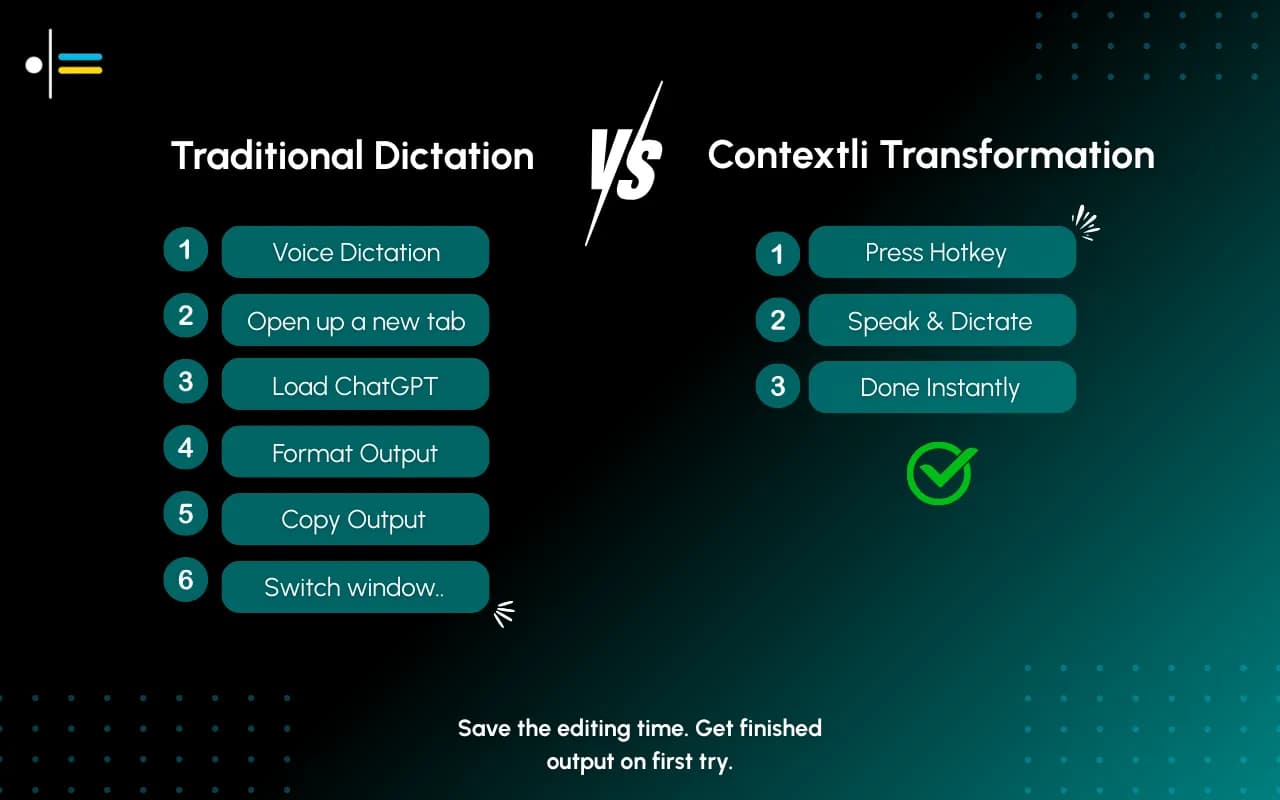
While many voice recognition tools offer basic speech-to-text functionality, Contextli distinguishes itself by addressing a critical pain point for professionals: the need for context-aware communication. People naturally adjust their writing style based on the platform-an email differs from a Slack message, which differs from personal notes. Traditional dictation tools treat all speech the same, forcing users to manually adapt tone, structure, and formatting. Contextli solves this with its innovative "Modes."
Contextli's Modes are context-aware processing profiles that automatically adapt your spoken words to the right output format, ensuring your voice becomes the appropriate kind of text for each scenario:
- Email Mode: This mode processes your speech into professional, neutral-toned text with proper structure. For example, a professional consultant uses Contextli's Email Mode to draft formal client communications, ensuring a professional and neutral tone with proper structure, thereby reducing the time spent on editing and enhancing clarity in correspondence. This eliminates the need for extensive editing to achieve a formal tone.
- Messaging Mode: Designed for platforms like Slack or WhatsApp, Messaging Mode transforms your speech into conversational and concise text. An executive employs Contextli's Messaging Mode to quickly compose concise and conversational messages for team collaboration platforms like Slack, facilitating efficient and effective communication within the team. This is ideal for quick team updates or informal discussions.
- Notes Mode: When you need to capture ideas quickly, Notes Mode converts your speech directly into organized bullet points. This helps professionals maintain structured thoughts without the hassle of manual formatting.
- LinkedIn Mode: Crafting professional yet engaging social posts is made easier with LinkedIn Mode, which applies a professional-casual tone suitable for networking and thought leadership content.
- Marketing Copy Mode: For content creators and marketers, this mode helps generate benefit-driven, persuasive writing, optimizing your spoken ideas for effective marketing outreach.
- General Dictation: This mode provides clean, accurate transcription, preserving the meaning of your speech without imposing a specific stylistic context. It's perfect for raw text input where context-specific formatting isn't required.
Contextli's approach ensures that professionals can "speak once" and "write appropriately everywhere," significantly reducing friction, extra editing, and cognitive load associated with switching communication styles. This focus on appropriateness and clarity sets Contextli apart from competitors that primarily emphasize speed or generic AI models.
When evaluating voice recognition software, professionals often look for accuracy, ease of use, and integration capabilities. While many tools offer basic voice to text technology, their effectiveness for diverse professional communication needs can vary significantly.
| Feature |
Traditional Voice Recognition Software |
Contextli |
| Primary Focus |
Speed, basic transcription |
Appropriateness, clarity, context-awareness |
| Output Style |
Generic, raw text |
Context-tailored (e.g., formal email, concise message) |
| Cognitive Load |
High (manual tone/structure adjustment) |
Low (automatic adaptation) |
| Editing Required |
Extensive |
Minimal |
| Target User |
General dictation users |
Professionals with diverse communication needs |
| Key Differentiator |
Accuracy of transcription |
Context-aware "Modes" for varied platforms |
Many general dictation tools, such as basic Google Docs Voice Typing or standard voice to text for Windows functionalities, excel at converting speech to text with reasonable accuracy. However, they typically provide a raw transcript that requires substantial manual editing to fit the specific tone, structure, and formatting required for different communication channels. For instance, a professional might use Windows speech recognition for general note-taking, but then spend considerable time rephrasing and structuring the text for an official email. Similarly, mac speech to text features offer convenience but lack the contextual intelligence needed for varied professional output.
Contextli's primary differentiator is its focus on appropriateness and clarity, rather than just speed or raw transcription. It understands that a professional's voice needs to adapt to the context-whether it's an email, a Slack message, or a LinkedIn post. This targeted approach significantly reduces the "friction, extra editing, and cognitive load" that professionals experience when using conventional tools. By offering specific "Modes," Contextli ensures that the output is not just accurate, but also immediately usable in its intended context, making it a powerful voice recognition software for professionals who value simplicity, predictability, and professional output.
Benefits of Using Voice Recognition Technology
The adoption of voice recognition technology offers a multitude of benefits for professionals, leading to significant improvements in productivity, communication quality, and overall work-life balance.

- Increased Efficiency and Productivity: Dictating text is often much faster than typing, especially for those who are not fast typists. This speed allows professionals to draft emails, reports, and notes more quickly, freeing up valuable time for other critical tasks. Professionals aged 40 and above are increasingly adopting voice recognition tools to enhance productivity, with a significant portion utilizing these technologies for tasks such as dictation, note-taking, and communication across multiple platforms.
- Reduced Cognitive Load: Constantly switching between different communication styles and manually editing text to fit various platforms can be mentally taxing. Tools like Contextli, with their context-aware Modes, alleviate this burden by automatically adjusting the output, allowing professionals to focus on the content of their message rather than the mechanics of its delivery.
- Enhanced Accuracy and Clarity: While initial dictation might require some correction, advanced voice recognition software, especially those with language models tailored for professional use, can produce highly accurate text. Contextli's Modes further enhance clarity by ensuring the tone and structure are appropriate for the specific context, reducing misinterpretations.
- Improved Accessibility: For individuals with physical limitations that make typing difficult or impossible, voice recognition software provides an essential means of interacting with computers and performing job duties. This promotes inclusivity in the workplace.
- Multitasking Capabilities: Voice input allows professionals to continue working on other tasks, such as reviewing documents or performing physical actions, while dictating. This hands-free operation is particularly beneficial in fast-paced or hands-on environments.
- Better Idea Capture: The ability to speak thoughts as they come can help professionals capture ideas more freely and comprehensively than typing, which can sometimes interrupt the flow of thought. This is especially useful for brainstorming or rapid note-taking.
- Consistency in Professional Output: For organizations, using a tool that ensures consistent, appropriate tone and structure across different communication channels helps maintain a professional brand image.
The global voice recognition market was valued at USD 18.39 billion in 2025 and is projected to reach USD 61.71 billion by 2031, growing at a compound annual growth rate (CAGR) of 22.38% during the forecast period (2026 - 2031). This substantial growth underscores the increasing recognition of these benefits across industries.
Challenges and Limitations
While voice recognition technology offers significant advantages, professionals should also be aware of its potential challenges and limitations. Understanding these can help manage expectations and implement strategies to mitigate their impact.
- Accuracy and Error Rates: Despite significant advancements, no voice recognition system is 100% accurate. Errors can arise from accents, background noise, unclear pronunciation, or homophones (words that sound alike but have different meanings). These errors necessitate proofreading and manual correction, which can sometimes negate the time-saving benefits.
- Background Noise: Noisy environments can severely degrade the performance of voice recognition software. Even sophisticated algorithms struggle to differentiate between speech and ambient sounds, leading to higher error rates.
- Accents and Dialects: While many systems are improving, strong or unfamiliar accents can still pose a challenge, requiring the user to speak more slowly or clearly, or to train the software to their specific voice patterns. Asia led the voice recognition market with a 32.5% share in 2024, driven by multilingual interface demand and strong chip manufacturing ecosystems, indicating ongoing efforts to address linguistic diversity.
- Punctuation and Formatting: Basic voice recognition often requires users to explicitly state punctuation (e.g., "comma," "period," "new paragraph"). While some advanced systems can infer punctuation, consistent and correct formatting still often requires manual intervention or specific commands.
- Privacy and Security Concerns: Dictating sensitive or confidential information raises privacy concerns, especially with cloud-based voice recognition services where data is processed remotely. Professionals must ensure that the software they use adheres to strict data privacy and security protocols.
- Cognitive Adjustment: Shifting from typing to dictating requires a different cognitive process. Some professionals may find it challenging to articulate their thoughts clearly and concisely in spoken form, especially for complex or highly structured documents, without the visual feedback of typing.
- Learning Curve: While often intuitive, mastering voice commands and optimizing the software for personal use can involve a learning curve. Users may need to spend time training the system or learning specific commands to maximize efficiency.
- Limited Customization for Context: Most generic voice recognition tools lack the ability to automatically adapt output for different communication contexts, forcing professionals to manually edit for tone, structure, and formality. This is precisely the problem Contextli aims to solve with its specialized Modes.
Conclusion
Voice recognition technology has evolved into an indispensable tool for modern professionals, offering profound benefits in efficiency, accuracy, and accessibility. By translating spoken words into text, it streamlines communication, reduces cognitive load, and empowers individuals to manage their diverse professional responsibilities with greater ease. The rapid growth of the global voice recognition market underscores its increasing importance and adoption across various industries.
While general voice recognition software provides fundamental speech-to-text capabilities, solutions like Contextli elevate this technology by introducing context-aware "Modes." These innovative features recognize that professional communication is not monolithic; an email requires a different tone and structure than a Slack message or a LinkedIn post. By automatically adapting spoken input to the appropriate format-whether it's Email Mode for formal correspondence or Messaging Mode for concise team updates-Contextli




 Junaid Khalid