

Client Meeting SummaryJul 29, 2026
Client Meeting Notes Template: The Format Clients Want Sent Back
A client meeting notes template with the exact 6 sections clients want emailed back to them, plus a faster way to fill it in by voice.
 Junaid Khalid
A workflow guide to the best voice-to-text tool for consultants, covering client-email customization, internal Slack, and the privacy controls confidential client work needs.

A consultant's day is a series of register switches. A formal recommendation email to a client in the morning. A blunt internal Slack to your delivery lead an hour later. A LinkedIn comment between meetings. Each one needs a different tone, and typing them all is where the hours go. Knowledge workers spend close to 28% of the workweek reading and writing email, roughly 11 hours, and the heaviest users, client-facing managers and advisors, sit nearer 8.8 hours on email alone. That is most of a billable day spent moving words around.
Dictation should fix this. Most dictation tools do not, because they hand you raw transcription that still sounds like a transcript. This guide walks through what consultants actually need from a voice-to-text tool, how to set one up for the way you switch between client and internal writing, and how the leading tools compare.
A consultant's writing is not one thing. The recommendation memo to a client reads differently from the Slack message asking your analyst to redo a slide. The tone, the length, the formality, even the sign-off all change depending on who is reading.
Generic dictation tools treat all of this the same. You speak, they transcribe, and you are left editing the result into the right register by hand. That editing is the slow part. For a consultant billing by the hour, it is also the expensive part.
What you actually need is a tool that knows the difference between a client email and an internal message, and writes each one appropriately from the same spoken input. That is the gap context-aware dictation fills.

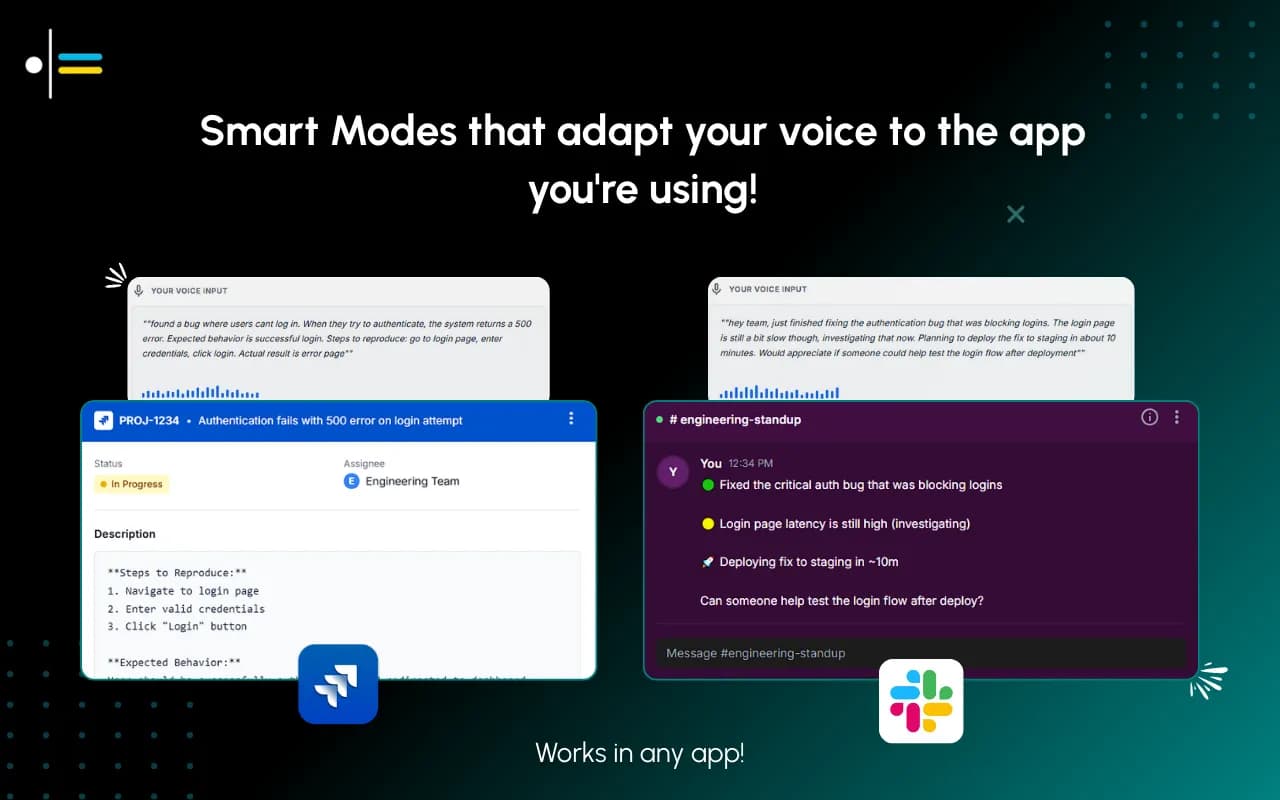
Contextli is built around Modes: Email Mode, Messaging Mode, Notes Mode, LinkedIn Mode, Marketing Copy Mode, and General Dictation. The base Modes are the starting point. The actual win for a consultant comes from customizing them.
Feed Email Mode three or four examples of how you actually write to clients: your sign-off style, your sentence length, your preferred opening. From then on, every dictated email matches that voice. You can give it specific instructions too: always use UK spellings, never open with the word "I", sign off as your first name only. Same for Messaging Mode, which you would set up to sound shorter and more direct for internal Slack.
If you turn on screen-awareness (off by default, you control it), Contextli can see what you are looking at when you dictate. You are reading a client email with three questions in it. You hit the hotkey and say "let them know I am traveling Thursday and Friday, but the revised model will be ready Monday." Contextli already knows the client's name, your name, and the three questions in context, and writes the reply addressing each one, properly opened and closed. You read it, make one edit, send.
A management consultant finishes a client call at 4:55pm. The client asked for a quick written summary of the two options discussed and a recommendation. If the raw meeting notes need tidying first, our free meeting notes formatter turns them into a clean structure in seconds. Normally this is a 15-minute task: open the email, find the right tone, draft, re-read, soften two sentences, send.
Instead, the consultant has already customized Email Mode with five of their past client recommendation emails, formal, structured, never hedging more than necessary. They hit the hotkey and talk through the two options and the recommendation in plain speech, the way they would explain it out loud. Contextli produces a structured email in their established client voice: a one-line context opener, the two options as a short list, a clear recommendation, and their usual sign-off. The consultant reads it, fixes one number, sends. Total time: about 90 seconds against the 15 minutes typing would have taken.
Ten minutes later they need to tell their analyst the client picked option B and the deck needs reworking tonight. They switch to Messaging Mode, which they set up to be short and direct, and dictate two sentences into Slack. No formal opener, no sign-off, exactly the internal register.
Consultants handle confidential client information constantly: financials, strategy, things under NDA. Where your dictation gets processed matters.
Contextli gives you three levels of privacy control. Use any of them, or stack all three.
Level 1: Local models. Transcription and AI processing run on your own machine. Internet off, app still works. You will need a modern Mac or Windows laptop, not a ten-year-old machine.
Level 2: Bring your own key. You supply the API key for transcription or AI, and your data goes from your machine to the provider directly. Contextli never sees it.
Level 3: Disable cloud sync. Cloud sync is how Contextli lets you use the same notes across devices. Turn it off and Contextli stores nothing in our database. Your transcribed notes live as local files on your machine, where you can browse them yourself.
Combine all three and Contextli never makes a single request to our servers. Fully offline, fully private. This matters here because the alternatives do not offer it. Wispr Flow is cloud-only, with no local mode and no bring-your-own-key, and by default it captures screenshots of your active window to add context, sending that plus your voice to cloud servers. For a consultant looking at a client's confidential deck, that is a hard no. Willow Voice has a local processing option but no bring-your-own-key and no equivalent cloud-sync-off stack.
The table below shows where each tool lands on the controls that matter most for consultant work.
| Control | Contextli | Wispr Flow | Willow Voice | Apple Dictation |
|---|---|---|---|---|
| Local model mode | Yes | No | Partial | Yes |
| Bring your own key | Yes | No | No | No |
| Disable cloud sync | Yes | No | No | N/A |
| Customize by example | Yes | No | No | No |
| Per-channel Modes | Yes | No | No | No |
| Price (individual) | Free tier, paid plans | $12/mo annual | $12/mo annual | Free |
Apple's native dictation is free and runs on-device, which is genuinely private, but it is pure transcription. It has no concept of a client email versus an internal message, and no customization. Wispr Flow is fast and polished; if all you need is quick transcription, it is a fair pick, but it cannot write in your client voice and its privacy defaults are wrong for confidential work.
The chart below summarizes the wedge on the controls that decide it for consultants.

Three things, in order. First, can it write in different registers for different channels, not just transcribe? A consultant's client email and internal Slack are different jobs. Second, can you customize it with your own writing, so the output sounds like you and not a generic assistant? Third, does it give you real control over where confidential client data is processed?
A tool that does all three saves a consultant more than typing time. It removes the editing step that turns a 90-second task back into a 15-minute one, and it does it without putting client data somewhere you cannot account for.
For consultants who switch between formal client emails and blunt internal messages, Contextli fits best because it customizes per channel with your own writing examples and offers a full privacy stack. Wispr Flow and Willow Voice are reasonable if you only need fast transcription.
Yes, if it supports customization by example. Contextli's Email Mode lets you feed in past client emails so dictated drafts match your tone, length, and sign-off. Most dictation tools only transcribe and cannot do this.
It depends on the tool. Contextli can run fully offline with local models, bring-your-own-key, and cloud sync disabled, so no data leaves your machine. Cloud-only tools like Wispr Flow send your voice, and sometimes screenshots, to external servers.
Client-facing professionals spend close to 8.8 hours a week on email. Dictating client emails in a customized Email Mode can turn a 15-minute drafting task into roughly 90 seconds, with the editing step largely removed.
Contextli works at the system level and types into whatever window you have focused, including your email client, Slack, or any other app. It does not use a Slack or Gmail API integration; it writes directly into the focused window.
For local models you need a modern Mac or Windows laptop. A current machine runs local processing fine. A very old laptop will be slow, which is the honest trade-off for keeping everything on-device.
Yes. You set up Email Mode for formal client writing and Messaging Mode for short internal messages, each customized with its own examples and instructions. You switch between them with a hotkey as you move between tasks.
If you want to see how Email Mode handles client writing in detail, read Email Mode: how Contextli writes client emails from a single hotkey. To set up your own Modes with examples, see how to customize Contextli Modes with examples of your own writing. For the full picture on context-aware dictation, start with the guide to context-aware speech-to-text for professionals. If you are weighing alternatives, compare Wispr Flow vs Contextli and Willow Voice vs Contextli.
Pick the next recommendation email you owe a client and dictate it in a customized Email Mode instead of typing it. You will see whether the draft comes out in your voice and how much of the editing step disappears. Contextli's free tier gives you 100 credits a month, no credit card required. See how consultants use Contextli on the use-cases page.

Junaid Khalid
Founder & CEO
Founder and solopreneur writing about how modern businesses run leaner and faster with AI. I build software that turns everyday work, from capturing thoughts to writing and staying organized, into something effortless, and I share what I learn along the way.
A client meeting notes template with the exact 6 sections clients want emailed back to them, plus a faster way to fill it in by voice.
Junaid Khalid
How to build a searchable cigar tasting library by voice. Log wrapper, burn, draw, and flavor notes right after each smoke, before the details fade.
Junaid Khalid
A bug report template with repro steps, environment, and expected versus actual behavior. Copy the seven fields and cut the back-and-forth.
Junaid Khalid