A developer picks up a ticket that says "login broken, fix ASAP." No steps, no browser, no error message. They reply asking which login, on what device, with which account. The reporter answers three hours later, and the developer still cannot reproduce it. Two days pass on a bug that would have taken twenty minutes if the first ticket had carried the right fields. Most bug reports fail here, not in the code but in the description, and a fixed template solves most of it.
Key takeaways
- A usable bug report needs seven fields: title, steps to reproduce, expected result, actual result, environment, severity, and evidence.
- The single biggest time sink is a missing repro path. If a developer cannot trigger the bug, they cannot fix it, and the ticket bounces back to you.
- Numbered steps beat paragraphs. A tester who writes "1, 2, 3" gets reproduced on the first read far more often than one who writes a story.
- Dictating a bug report while you still have the broken screen open captures detail you forget by the time you switch to the tracker.
- A template is not bureaucracy. It is the difference between one round-trip and five on the same bug.
Why most bug reports waste developer time
The gap between a good and a bad bug report is not effort, it is structure. A reporter who spends five minutes writing prose often produces a worse ticket than one who spends ninety seconds filling fixed fields, because prose lets you skip the boring parts your reader needs most.
Three failures show up again and again. First, no reproduction path, so the developer guesses at the trigger. Second, "expected" and "actual" collapsed into one sentence like "it should work but it doesn't." Third, no environment, so a bug that only appears on Safari 17 gets tested on Chrome and marked "cannot reproduce." Each of those failures costs a round-trip, which on a distributed team is often the next working day once time zones are counted. A product bug report that carries all seven fields on the first pass removes that tax.
The 7 fields a bug report template needs
A bug ticket is a small contract: it promises the developer enough to reproduce, understand, and prioritize the problem without asking you anything. Seven fields cover that for almost every software bug.
| Field |
What it answers |
Bad example |
Good example |
| Title |
What is broken, in one line |
"Bug in app" |
"Checkout: Pay button disabled after coupon applied" |
| Steps to reproduce |
How to trigger it |
"Try the checkout" |
"1. Add item 2. Apply coupon SAVE10 3. Click Pay" |
| Expected result |
What should happen |
"It should work" |
"Pay button stays active, order submits" |
| Actual result |
What happens instead |
"It's broken" |
"Pay button greys out, no error shown" |
| Environment |
Where it happens |
"My laptop" |
"Safari 17.2, macOS 14.3, staging build 482" |
| Severity |
How much it hurts |
"Urgent!!!" |
"High: blocks all coupon checkouts" |
| Evidence |
Proof it is real |
(none) |
Screenshot + console error attached |
The two fields people skip most are environment and evidence, and they are the two that decide whether the bug is reproducible.
Steps to reproduce: the field that decides everything
If you fix only one habit, make it this one. A developer's workflow starts with reproducing the bug: no reproduction, no fix, and the ticket comes straight back to your queue. Write steps as a numbered list, one action per line, starting from a known state. "Log in as a test user, open the dashboard, click Export" is reproducible. "When I export sometimes it fails" is not. Include the exact data you used, because a bug that only fires with a coupon code, a 200-character name, or an empty cart will hide behind vague steps forever. State the account and permissions too: a bug an admin sees and a standard user does not is a different bug.
Writing the report while the bug is still fresh
The best time to write a bug report is the moment you hit the bug, with the broken screen in front of you. The console error is still there and the input that triggered it has not blurred. Come back twenty minutes later and half the detail is gone.
This is where dictation earns its place in a QA workflow: speaking a report while looking at the failure keeps your eyes on the evidence. The catch with generic dictation is that spoken words come out as a run-on wall of text, the opposite of the numbered, fielded structure a good ticket needs.
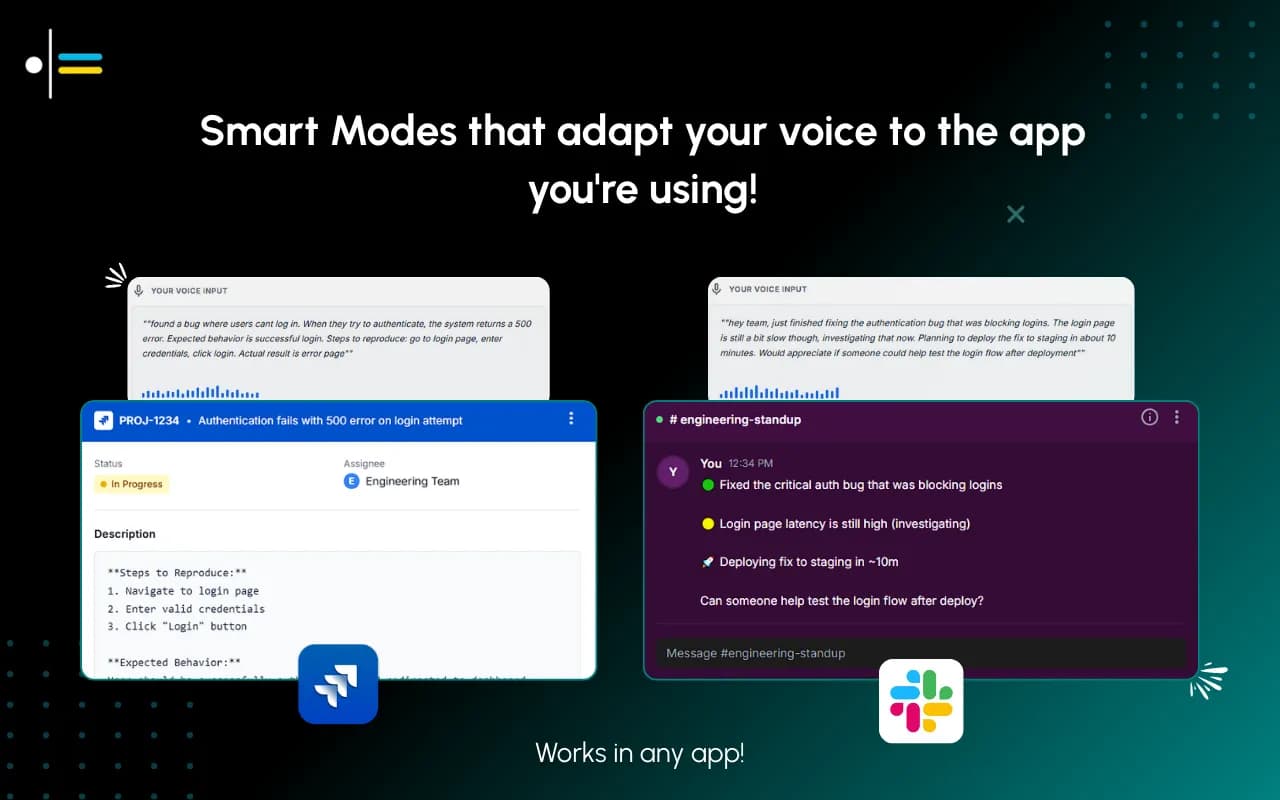
Contextli handles this with its context Modes. In Notes Mode you give the Mode a few samples of your bug-report style plus an instruction like "format spoken steps as a numbered list, keep expected and actual on separate lines," and it shapes your dictation into that structure. Contextli types system-level into whatever window has focus, so the text lands directly in your tracker's description field. Screen-awareness is off by default; when you turn it on for a session, the Mode can read the on-screen error text so the ticket names the exact message rather than "some error."
In practice: a QA engineer hits a payment failure on staging. She presses her Contextli hotkey and speaks the report while the failing screen and console are open, using Notes Mode with her saved bug-report examples. In about 40 seconds she dictates the title, three numbered repro steps, expected result, actual result, and the Safari version, and it lands in the tracker already formatted. She attaches the screenshot and moves on, and the developer reproduces it on the first read with no reply needed.
Severity, priority, and evidence: helping developers triage
A bug report does not just describe a problem, it helps someone decide when to fix it. Severity says how badly the bug hurts (a crash is high, a misaligned icon is low). Priority says how soon it should be scheduled, a business call the reporter can suggest but the team owns. Keeping them separate stops the "everything is urgent" spiral that makes severity meaningless.
Evidence turns a claim into a reproducible fact. A screenshot shows the visual state, a recording shows the sequence, and a copied console error or stack trace often points straight at the line of code. One console error attached to a ticket can save an hour of a developer guessing at the cause. For deeper issues, linking a debugging session log or a related code review note shows the trail of what was already checked.
Where bug reports fit alongside your other dev docs
A bug report rarely lives alone. A feature request note answers "what should we build and why," while a bug report answers "what is broken and how do I see it." An on-call incident note needs a timeline rather than repro steps, but it benefits from the same "capture it while it is fresh" habit. Contextli's context Modes exist because each document wants a different shape from the same spoken input, so one Mode per document type keeps the output right without reformatting by hand. The full set of these structures lives in the Contexts hub.
How dictated bug reports compare to typing them
The case for dictation is specific: you are looking at a live failure and want to capture it before it fades.
| Approach |
Speed at capture |
Keeps eyes on the bug |
Output structure |
Privacy control |
| Typing into the tracker |
Slower, you look away to type |
No, you switch windows |
Whatever you type |
Full, stays local |
| Generic dictation tool |
Fast |
Yes |
Run-on paragraph |
Varies by tool |
| Contextli Notes Mode |
Fast |
Yes |
Numbered steps, fielded |
Local models or BYOK, off cloud sync |
On raw dictation speed, tools like Wispr Flow are built for exactly that and win on it. Contextli's difference is not speed, it is that the output arrives already shaped like a bug ticket, and that you can run transcription on local models on-device or through your own API key (BYOK) so an internal-only bug description never touches a vendor's servers. For teams filing bugs about unreleased features, that privacy control is the deciding factor. There is more on that trade-off in the dictation privacy guide.
Bug report template infographic
The seven fields, in the order they should appear on the ticket:
- Title: one specific line
- Steps to reproduce: numbered, one action each
- Expected result: what should happen
- Actual result: what happens instead
- Environment: OS, browser, build
- Severity: crash, blocker, minor
- Evidence: screenshot, console error
Fill all seven and the developer reproduces on the first read.

FAQ
What is a bug report template?
A bug report template is a fixed set of fields you fill in for every software bug so the developer gets consistent, complete information: title, steps to reproduce, expected result, actual result, environment, severity, and evidence. Using the same issue report format across a team means anyone can read any ticket without relearning where the details are.
What are the most important fields in a software bug report?
Steps to reproduce and environment matter most, because together they decide whether a developer can trigger the bug at all. Without a clear reproduction path, the ticket bounces back. After those, expected versus actual behavior and attached evidence (a screenshot or console error) do the most to shorten the fix.
How detailed should steps to reproduce be?
Detailed enough that someone who has never seen the bug can follow the numbered steps and hit it on the first try. Start from a known state, list one action per line, and include the exact input data, account, and permissions you used. Vague steps like "try exporting" are the top cause of a QA bug template failing in practice.
What is the difference between severity and priority?
Severity measures how badly the bug hurts (a crash is high, a cosmetic glitch is low). Priority measures how soon it should be scheduled, a roadmap decision. A low-severity bug on a marketing page before a launch can still be high priority. Keeping the two fields separate stops every ticket from being marked urgent.
Can I dictate a bug report instead of typing it?
Yes, and doing it while the failure is still on screen captures detail you tend to forget after switching windows. The problem with plain dictation is that speech comes out as one long paragraph. Contextli's Notes Mode, given a few examples of your bug-report style, shapes spoken input into numbered steps and separate expected and actual lines, then types it into your tracker.
Does a bug tracking template slow down reporting?
No. A template is faster than free-form prose once you have used it a few times, because you stop deciding what to include and just fill the fields. Ninety seconds of structured reporting routinely saves several round-trips of clarification, so the net time spent on the bug drops.
Set up a bug-report Mode in Contextli, feed it three of your own past tickets, and your spoken reports will land in your tracker already formatted as numbered steps with expected and actual behavior split out, so developers reproduce on the first read. The free tier gives you 100 credits per month, no credit card required. Download Contextli and file your next bug by voice.



 Junaid Khalid