

Home Maintenance TrackerAug 4, 2026
Home Maintenance Log: Track Every Repair Before Warranty Ends
Build a home maintenance log that captures every repair, part, and warranty date by voice so nothing slips before coverage ends.
 Junaid Khalid
A goal setting app only works if you reopen it. Here is how to log goals by voice in 20 seconds so the Monday review actually happens.
Most goal setting apps die on a Wednesday in week three. You set five goals in January with real intent, the notifications pile up unread, and by February the app is a graveyard you avoid opening, because opening it means admitting you stopped. The problem is rarely the goals. It is that reviewing them has friction, and typing a thoughtful weekly update after a full day feels like homework, so you skip it, and one skip becomes a habit.
If you spend most of your week making decisions and switching between six tools, the goal that survives is the one you can revisit in under a minute. Not the one with the prettiest dashboard. This guide is about building a goal log you will actually reopen on Monday, and where dictating your check-in beats typing it.
Every goal planning app sells you on the setup: colorful onboarding, milestone templates, a satisfying progress ring. Setup is the easy part, though. You were motivated the day you installed it, so of course you filled everything in.
The part that decides whether the app survives is the review. A goal you never revisit is a note, not a goal. And the review is where almost every tool quietly asks too much: open the app, find the goal, remember what you did last week, type a paragraph, update a percentage, tag it. Across five goals that is 15 minutes of admin before you have moved anything forward.
So you do it once. Maybe twice. Then a busy Monday arrives, you tell yourself you will catch up tomorrow, and the log falls a week behind. A week behind feels like failure, failure feels bad to look at, and now the app is something you avoid. The goals did not change. The cost of checking in did.
The fix is not more discipline. It is to make the check-in so short that skipping it saves you no real time.
You do not need an OKR tracker app with 40 fields. For a weekly review that survives, each goal needs four things and nothing more.
The outcome. One sentence, written as a result, not an activity. "Ship the onboarding rebuild" is an activity. "Cut step-2 drop-off from 40 percent to under 25 percent" is an outcome you can check.
The current number. Every real goal has a number: revenue, weight, drop-off rate, chapters written, calls booked. If a goal has no number, it is a value, and values do not belong in a weekly log.
The next action. The single next physical step. Not the plan. The one thing you would do if you had 30 minutes right now.
One blocker. The thing most likely to stall you this week. Naming it is half of clearing it.
That is your goal log template. Four fields, one paragraph. Here is what a filled row sounds like, spoken aloud: "Q3 revenue goal, at 41 thousand of the 60 thousand target, next action is to send the three renewal quotes I drafted, blocker is I am waiting on legal to approve the new contract terms."
Written out cleanly, that is a complete weekly update. Spoken, it took about 12 seconds. The point of the four-field structure is that it is short enough to say out loud in one breath per goal.
Here is the honest math on why goal logs go stale. A thoughtful typed update for one goal, the kind with a real next action and a named blocker, runs 3 to 4 minutes once you account for finding the goal, remembering the context, and phrasing it. Five goals is 15 to 20 minutes at the end of a day when your typing energy is gone.
Speaking the same five updates takes about 90 seconds. The gap between 90 seconds and 20 minutes is the gap between a habit that holds and one that dies.
This is where a dictation tool earns its place in a goal setting workflow. Not to write your goals for you, but to remove the typing tax on the review. You look at the goal, say the four fields out loud, and the update lands in your app already formatted. The barrier to a Monday check-in drops from "find 20 minutes and mental energy" to "talk for a minute and a half."
A goal you can update by talking for 90 seconds is a goal you will still be tracking in March. A goal that costs 20 minutes of typing is a goal you will abandon by February.
The market splits into two rough camps: full goal planning apps with dashboards, and lightweight notes you keep yourself. Neither removes the typing tax on its own. A dictation layer does, and it works with whichever camp you prefer.
| Approach | Setup effort | Weekly check-in cost | Where your data lives | Best for |
|---|---|---|---|---|
| Dedicated goal setting app (dashboards, OKR fields) | High, guided onboarding | 10 to 20 min typing across goals | Vendor cloud, varies | People who love a dashboard and will maintain it |
| Spreadsheet goal tracker | Medium, build your own grid | 5 to 15 min typing per week | Your drive or vendor cloud | People who want full control of columns |
| Plain notes app with a goal log template | Low | 15 to 20 min typing | Notes app cloud, or local | Minimalists who resist heavy tools |
| Any of the above plus voice dictation | Same as chosen tool | About 90 sec speaking, all goals | Your app, plus your dictation setup | Anyone who keeps abandoning the review step |
The row that matters is the last one. Contextli does not replace your goal setting app or your spreadsheet. It is a desktop app that types into whatever window is focused, so it drops a clean update straight into the tool you already chose. There is no integration to configure, because it works at the system level and types where your cursor is.
Contextli is context-aware desktop dictation. That matters here for one reason: a goal update is not the same kind of writing as a Slack reply or a marketing headline, and a tool that writes all three the same way produces text you have to re-edit anyway.
You feed a Contextli Mode 3 to 4 examples of how you want goal updates to read, or a plain instruction like "always write goal updates as: outcome, current number, next action, blocker, in that order." From then on, every dictation into that Mode comes out in that exact shape. You speak the messy version, and it types the clean structured one. That is the customization-by-example flow, and for a repeating weekly format it pays off every Monday.
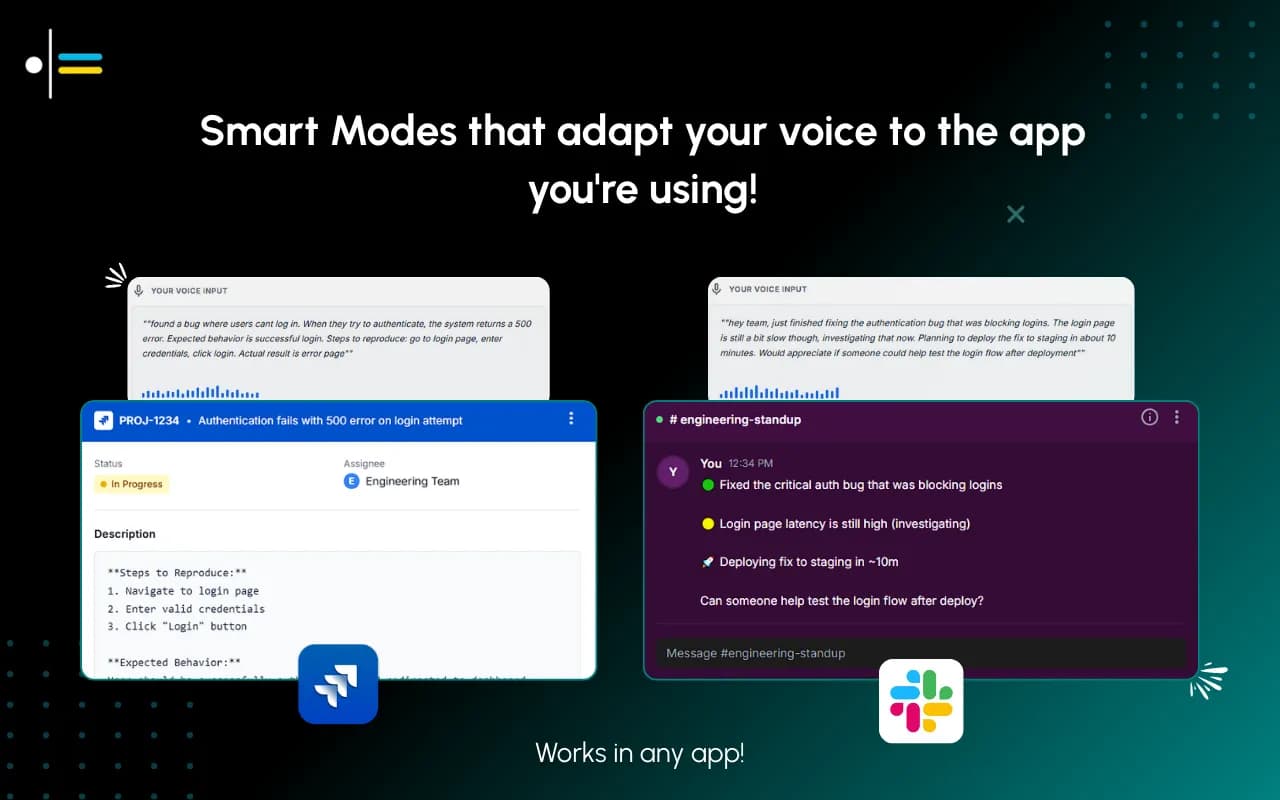
Contextli runs 6 real Modes: Email Mode, Messaging Mode, Notes Mode, LinkedIn Mode, Marketing Copy Mode, and General Dictation. For goal logging, Notes Mode is the natural home. Set it up once with your four-field template as the instruction, and the review stops being a writing task.
There is also the privacy question, which for a goal log is not trivial. Your goals often name revenue targets, hiring plans, or personal numbers you would not want on a vendor's server. Contextli lets you stack three privacy levels: run transcription and AI processing with local models on your own machine, bring your own API key so data goes straight from your machine to the provider you chose, or turn off cloud sync so Contextli stores nothing and your notes live as local files. Stack all three and your goal log never leaves your laptop. The honest trade-off on local models is that they want a modern Mac or Windows machine; older hardware runs them slowly.
To be fair about where it does not fit: if all you want is a voice memo transcribed verbatim with zero formatting, a faster pure-transcription tool like Wispr Flow gets you raw text quicker. Contextli's value shows up when the words need to land in a specific shape, which a weekly goal update always does.
Consider Maria, a product lead who tracks four quarterly goals and had quietly stopped updating them since week two. Typing a real update for all four ran about 14 minutes, so on busy Mondays she skipped it, and the skips compounded.
She sets up Notes Mode in Contextli with one instruction: write each goal update as outcome, current number, next action, and one blocker. Now her Monday looks like this. She opens her goal doc, puts her cursor under the first goal, presses the hotkey, and says: "Activation goal, at 31 percent against the 40 percent target, next action is to ship the tooltip changes I merged Friday, blocker is I need design sign-off on the empty state."
Contextli types the formatted line into the doc. She moves to the next goal and does it again. Four goals, four spoken updates, about 90 seconds of talking instead of 14 minutes of typing. Because it costs almost nothing, she does it every Monday, and by quarter-end she has a real week-by-week trail of where each goal moved and what stalled it.
That trail is the actual product of a goal setting app. Not the ring that fills up. The honest record you build by showing up to the review, which you only do if the review is cheap.

The weekly review, not the setup. Choose the tool whose check-in you can complete in under two minutes, because a goal you never revisit stops being a goal. Dashboards and streaks do not matter if reopening the app feels like a chore.
Only if your team runs formal OKRs and needs shared scoring. For personal goals, a four-field goal log template (outcome, current number, next action, blocker) in any notes app does the same job with far less overhead. An OKR tracker app adds structure you may not need to maintain.
It removes the typing tax on the review. Speaking a four-field update takes about 12 seconds per goal versus 3 to 4 minutes of typing. That gap is usually the difference between keeping the log current and letting it go stale by February.
No, and it does not need to. Contextli is a system-level desktop app that types into whatever window is focused. Put your cursor in your goal doc, spreadsheet, or notes app, dictate, and the formatted update appears there.
Yes. Run local models so transcription and AI processing happen on your machine, use your own API key so data goes machine to provider, and turn off cloud sync so Contextli stores nothing and your notes stay as local files. Stack all three and nothing about your goals leaves your laptop.
Give a Mode 3 to 4 examples of the format you want, or a plain instruction like "outcome, current number, next action, blocker, in that order." Every dictation into that Mode then comes out in that exact shape, so your weekly updates stay consistent without you reformatting them.
The free tier is 100 credits per month, no credit card required. That is enough to run several weeks of goal reviews and decide whether dictating the check-in actually keeps you coming back on Mondays.
Notes Mode. Set it up once with your four-field template as the instruction, and it will format every spoken goal update into that structure. Email Mode and Messaging Mode are tuned for their channels, so they are the wrong fit for a structured internal log.
To build a review habit that survives busy weeks, these are worth a look. Start with the Context Library hub for the full set of voice-first logging templates.
Pick your four goals, open whatever app you already use, and dictate this week's update instead of typing it. If the four-field format and a 90-second review keep you coming back next Monday, you have solved the part that actually breaks goal tracking.
See how the Notes Mode and privacy stack fit your goal log at contextli.com/features. The free tier is 100 credits per month, no credit card required, which covers weeks of reviews before you decide.

Junaid Khalid
Founder & CEO
Founder and solopreneur writing about how modern businesses run leaner and faster with AI. I build software that turns everyday work, from capturing thoughts to writing and staying organized, into something effortless, and I share what I learn along the way.
Build a home maintenance log that captures every repair, part, and warranty date by voice so nothing slips before coverage ends.
Junaid Khalid
A habit tracker app that survives your worst week: how to log by voice in seconds, recover broken streaks, and keep a private daily record.
Junaid Khalid
Build a gratitude journal for kids that actually sticks. A calm 3-minute nightly routine, prompts by age, and a hands-free way to capture their words.
Junaid Khalid