

Home Maintenance TrackerAug 4, 2026
Home Maintenance Log: Track Every Repair Before Warranty Ends
Build a home maintenance log that captures every repair, part, and warranty date by voice so nothing slips before coverage ends.
 Junaid Khalid
Build a gratitude journal for kids that actually sticks. A calm 3-minute nightly routine, prompts by age, and a hands-free way to capture their words.

Most gratitude journals for kids die in a drawer within two weeks. A young child cannot spell "grateful," gets bored halfway through a sentence, and a parent hovering with a pen turns a nice bedtime moment into a chore. So the notebook goes blank, and the habit that was supposed to stick never starts.
The fix is not a fancier notebook. It is removing the writing friction entirely, keeping the routine short, and letting your child speak instead of struggle with a pencil. Three minutes at bedtime, one prompt, done. This guide covers the routine, prompts by age, and a hands-free way to capture exactly what your child said before they forget it.
Ask a 6-year-old to write three things they are thankful for and you get one word, misspelled, then a stall. Handwriting is the slowest part of a child's day. It is physically tiring, and the effort crowds out the actual thinking about gratitude, which is the whole point.
Older kids (9 to 12) can write, but they treat a blank notebook like homework. The format signals "school," and the entries get shorter each night until they stop.
There is also the parent-labor problem. If you are the scribe every night, the practice depends on your energy, and it collapses the first week you are tired. A routine that only survives when the parent is at full capacity is a chore with a countdown.
The durable version has four traits, and none of them involve buying anything special.
It is short. Three minutes, one prompt, then bed. Anything longer competes with sleep and loses.
It is anchored. You attach it to something that already happens every night, like right after teeth-brushing or right before the last book. A new habit riding on an old habit survives far longer than a standalone one.
It is spoken, not written, for younger kids. Your child says their answer out loud. You capture it verbatim. The words are theirs, the effort is near zero, and the record is real.
It is rotated. One question a night, cycled through a small set, so it never becomes a fill-in-the-blank worksheet. Novelty is what keeps a 7-year-old engaged past week three.
The goal is not a perfect notebook. It is a two-minute nightly moment where your kid names one good thing and hears it read back.
Pick from the age band that fits, and use a different prompt each night so it stays fresh. Keep the whole thing to a single question.
| Age band | Prompt style | Example prompts |
|---|---|---|
| 3-5 (pre-writers) | Concrete, sensory, one thing | "What made you smile today?" / "Who was kind to you?" / "What was yummy today?" |
| 6-8 (early writers) | Specific people and moments | "Who helped you today and how?" / "What is one thing your body let you do today?" |
| 9-12 (fluent writers) | Reflective, cause-and-effect | "What went better than you expected?" / "Who would you thank if they were here?" |
| Whole family | Shared round-robin | "Best part of today?" said around the table, each person one answer |
For the youngest kids, resist correcting or expanding their answer. "The dog" is a complete, valid gratitude entry for a 4-year-old. Write down "the dog."
This is where the routine usually breaks, and where a dictation tool earns its place. Your child speaks the answer, and instead of you transcribing it by hand or typing while they wait, the words go straight into your notes.
Contextli is a desktop speech-to-text app that types into whatever window is focused. Open a note in Apple Notes, a plain text file, or your family log, put the cursor there, and Contextli types your child's spoken answer into it. It is a system-level app, so it works with the notes app you already use rather than asking you to move into a new one.
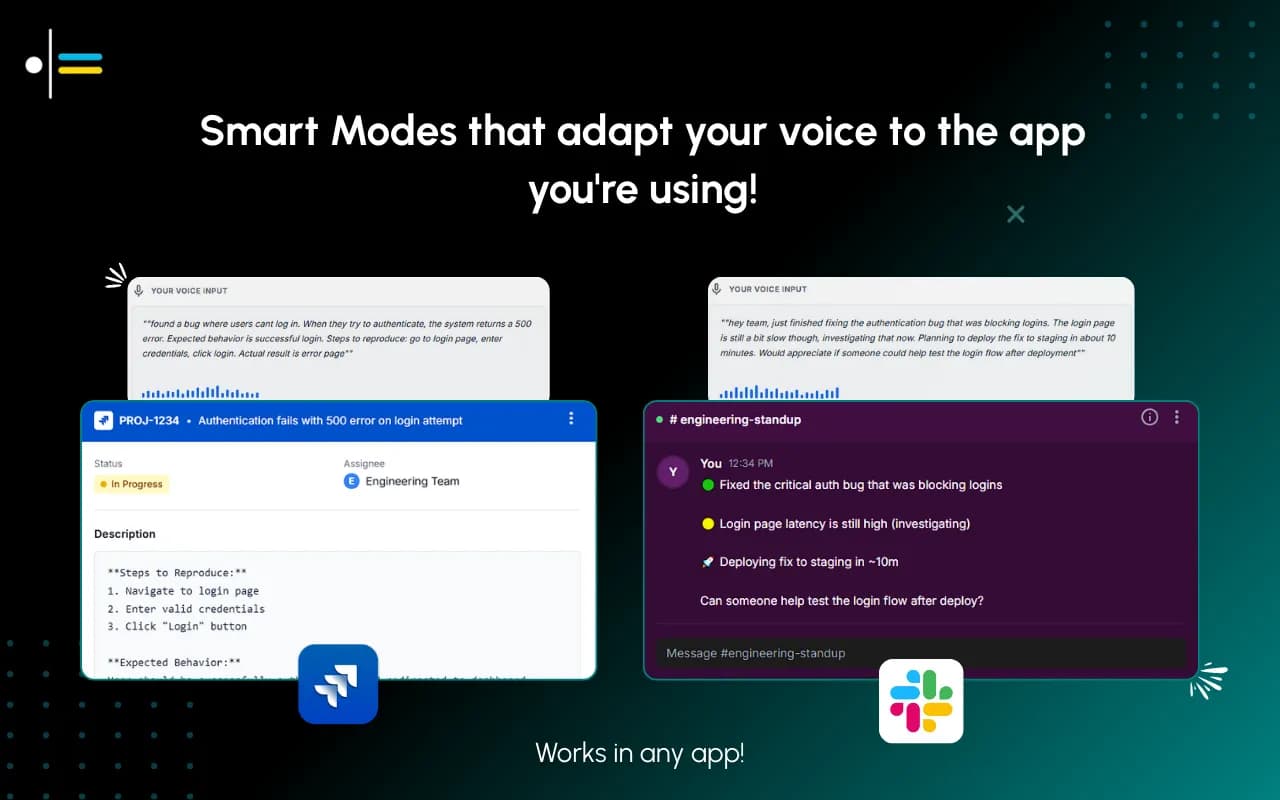
The part that matters for a gratitude log is Notes Mode. General dictation drops in raw speech with filler and false starts. Notes Mode keeps the entry clean and readable, so "um, I dunno, I guess the, the trampoline" becomes "The trampoline" without you editing it later.
You can also customize a mode with 3 to 4 examples of how you want entries to read. Feed it a few sample lines ("keep it in my kid's own words, first person, one sentence") and every future entry matches that shape. That is the difference between a tool that transcribes and one that writes the entry the way you actually want it logged.
For a nightly kids' routine, the appeal is the speed. Speaking one gratitude answer and having it land as a clean line takes a few seconds. Handwriting the same thing, legibly, takes a stalling 5-year-old a lot longer, if it happens at all.
A gratitude journal is a record of your child's inner life. Where those words live is a fair thing to care about.
Contextli gives you three privacy levels you can stack:
Local models. Transcription and the AI cleanup can run on your own machine with the internet off. The app still works offline. The honest trade-off: this needs a reasonably modern Mac or Windows laptop, and older machines run it slowly.
Bring your own key. If you would rather use a cloud model, you can supply your own provider API key. Your child's words go from your machine to that provider directly, and Contextli never sees the audio or text. You pay the provider directly.
Disable cloud sync. Turn sync off and Contextli stores nothing in its own database. Your family gratitude log lives as plain local files on your computer, yours to keep, back up, or read years later.
Stack all three and the whole routine runs fully offline and fully private. No competitor pairs local models, your own key, and no-server storage in one app.
There are simpler tools. Some are genuinely fine for part of the job. Here is an honest comparison for the specific task of logging a kid's spoken gratitude each night.
| Tool | Cleans up filler into a readable line | Runs fully offline | Types into your existing notes app |
|---|---|---|---|
| Contextli | Yes (Notes Mode) | Yes (local models) | Yes (system-level) |
| Apple/native macOS Dictation | No, raw transcript | Yes | Yes |
| Wispr Flow | Light cleanup, built for speed | No | Yes |
| Otter.ai | Meeting-style transcript | No | No, lives in its own app |
| Pen and paper | Not applicable | Yes | Not applicable |
If all you want is the fastest possible raw transcription, Wispr Flow is faster. For a nightly gratitude line you want to read back cleanly and keep private, the cleanup plus the offline option is the reason to reach for Contextli instead of native dictation.
It is 7:52pm. Maya, age 6, has brushed her teeth and is in bed. Her dad opens the family gratitude note on his laptop and puts the cursor at the top. Tonight's prompt: "Who helped you today?"
Maya says, "Um, my teacher, Miss Rowe, she helped me tie my shoe and also, um, at lunch." Using Notes Mode, Contextli types: "Miss Rowe helped me tie my shoe, and again at lunch." Dad reads it back to her. She grins, and it is 7:53pm.
Doing this by hand takes about 90 seconds of a tired parent transcribing while a 6-year-old loses interest. Spoken into Notes Mode, the entry lands in roughly 20 seconds, in Maya's own words, and the moment stays warm instead of turning into dictation-to-a-scribe. Over a year, that is 365 lines of a childhood you would not otherwise have written down.

Around 3 to 4 for a spoken version, where you capture one thing they name out loud. Written entries usually work from about 7 or 8, once handwriting is comfortable. Below that, keep it spoken so the effort does not kill the habit.
Aim for 3 minutes or less. One prompt, one answer, read it back, done. Anything longer competes with sleep and starts feeling like a worksheet.
That is normal and fine, especially for younger kids. If you want variety, rotate the prompt (a different question each night) rather than pushing them for a new answer. The repetition itself is a sign the thing genuinely matters to them.
No. A plain note or text file works. The useful piece is a way to capture their spoken words quickly, which is what a dictation app like Contextli does by typing into the notes app you already use. You do not need a dedicated children's gratitude app.
It can be fully private. With Contextli you can run local models offline and disable cloud sync, so entries live only as local files on your machine and nothing is sent to a server. See the dictation privacy guide for how the levels stack.
Yes. A round-robin at dinner ("best part of today?") with each person's answer captured into one shared note works well. Keeping it as a single local file means the whole family log stays in one searchable place for years.
The free tier includes 100 credits/month, no credit card required. That is enough to test the nightly routine for a while before deciding.
Once the kids' routine is running, these help you build and keep the habit for yourself too. Start with the gratitude journal app guide for building a practice that sticks, and read why gratitude journals fail after two weeks for the pattern that undoes most people. If capturing scattered thoughts is the hard part, the best brain-dump app for ADHD covers hands-free capture, and a mood tracker app pairs naturally with a gratitude log. To keep entries clean in your own voice, see how to customize Contextli modes with examples. You can browse the full set of everyday logging setups on the Contextli contexts library.
If handwriting is what keeps stalling your kid's gratitude journal, let them speak it instead. Contextli types their spoken answer into your family note in their own words, cleaned up in Notes Mode, with the option to run fully offline so the entries stay on your machine. Download Contextli and capture tonight's one thing in about 20 seconds. The free tier includes 100 credits/month, no credit card required.

Junaid Khalid
Founder & CEO
Founder and solopreneur writing about how modern businesses run leaner and faster with AI. I build software that turns everyday work, from capturing thoughts to writing and staying organized, into something effortless, and I share what I learn along the way.
Build a home maintenance log that captures every repair, part, and warranty date by voice so nothing slips before coverage ends.
Junaid Khalid
A habit tracker app that survives your worst week: how to log by voice in seconds, recover broken streaks, and keep a private daily record.
Junaid Khalid
A goal setting app only works if you reopen it. Here is how to log goals by voice in 20 seconds so the Monday review actually happens.
Junaid Khalid