Most sobriety apps count days and stop there. The number goes up, a badge appears, and none of it tells you what actually happened on the hard Tuesday when you nearly slipped. When you do want to write down a craving, a trigger, or a small win, the moment usually passes before you finish typing it on a phone. And a lot of these apps ship your notes to a server you cannot see, which is a strange thing to accept for something this personal.
This is a practical guide for people in recovery who want a sobriety log that captures the real thing without friction and without handing your words to a company. It covers what a good tracker should do, where a counter is enough and where a journal matters more, and how dictating a note by voice gets the entry down while you still remember it.
Key takeaways
- A sobriety app is most useful when it captures context (triggers, feelings, what helped), not just a day count.
- A running sobriety counter and a written recovery journal solve different problems; you often want both.
- Voice dictation gets an entry recorded in about 20 to 30 seconds, which matters when typing feels like too much.
- Privacy is not a nice-to-have here: with local models, your own API key, or cloud sync turned off, your notes never leave your machine.
- Contextli is a desktop dictation tool that types your spoken words into whatever app you already use for notes; the free tier is 100 credits/month on the free tier, no credit card required.
What a sobriety app should actually do
Strip away the streak animations and a sobriety app has one job: help you notice patterns you would otherwise forget. A day counter is the visible part, but the useful part is the record underneath it.
A recovery tracker app earns its place when it lets you log the things that predict a hard day. That means a quick note when a craving hits, a line about who you were with, a sentence on what you did instead. Read three weeks of those back and the pattern is obvious in a way that no streak number ever shows you.
The problem is friction. If logging an entry takes a minute of thumb-typing on a small screen, you skip it exactly when you most need it, in the middle of stress. The best sobriety log is the one you will still use at 11pm on a bad night, which usually means the fastest one.
Counter versus journal: which one you need
People search for a "sobriety counter app" and an "addiction recovery journal" as if they are the same product. They are not, and knowing the difference saves you from picking the wrong tool.
A counter answers "how long." It is a number, maybe a milestone alert, and it is genuinely motivating for a lot of people. A journal answers "why" and "what now." It holds the messy detail that a number cannot: the argument that set you off, the meeting that helped, the craving that passed after ten minutes.
Here is how the common tools line up.
| Tool type |
Tracks days |
Captures context/feelings |
Notes stay private on your device |
Fast to log in a hard moment |
| Sobriety counter app |
Yes |
No |
Varies by app |
Yes (nothing to write) |
| Recovery journal app |
Sometimes |
Yes |
Varies by app |
Slow if typed |
| Plain notes file + dictation |
Manual date |
Yes |
Yes, if stored locally |
Yes (spoken, ~25s) |
| Paper journal |
Manual |
Yes |
Yes |
Slow, not searchable |
The honest read: a counter and a written log cover different needs, and the friction of typing is what kills most recovery journals within a month. Removing that friction is the whole game.
When you are shaky, focused, or close to a slip, your hands and your patience are both in short supply. Typing a reflective paragraph in that state is a real ask, and most people simply do not do it. The entry that would have been most valuable is the one that never gets written.
Speaking is different. You can say what happened in the time it takes to think it. A note that would take 90 seconds to type takes about 25 seconds to say, and it comes out in your own words instead of the clipped shorthand you fall into on a keyboard.
That is where a system-level dictation tool fits. Contextli is a desktop app that types your spoken words directly into whatever window is focused, so your sobriety log lives in the notes app or plain text file you already trust. It has no special integration with any one journaling service; it types into whatever you have open, which is the point.
Privacy is the part most apps get wrong
A recovery journal is one of the most sensitive things a person keeps. It records relapses, shame, and names. Handing that to a cloud service you cannot audit is a lot to ask, and most sobriety apps ask it by default.
Contextli treats this as a ladder you control, in plain terms:
- Local models: transcription and the AI cleanup run on your own machine. You can turn the internet off and the app still works. The trade-off is honest: this needs a reasonably modern Mac or Windows laptop, and older machines run it slowly.
- Your own API key (BYOK): you supply a provider key, your audio and text go from your machine straight to that provider, and Contextli never sees either. You pay the provider directly.
- Cloud sync off: switch it off and Contextli stores nothing in its database. Your notes stay as local files on your disk.
Stack all three and the setup is fully offline and fully private. No competitor offers that combination. For a fuller walkthrough, see the dictation privacy guide.
How a sober living tracker looks in practice
A sober living tracker only helps if the daily entry actually happens. Here is what removing the typing friction does to that habit.
Maria is 40 days sober and keeps a plain text file on her laptop. A craving hits after a stressful call. She opens the file, uses Notes Mode, and speaks: "3pm, craving after the vendor call, stomach tight, went for a walk instead, it passed in about 15 minutes." The line is typed and saved in roughly 25 seconds. She would not have typed that; she would have told herself she would do it later and forgotten.
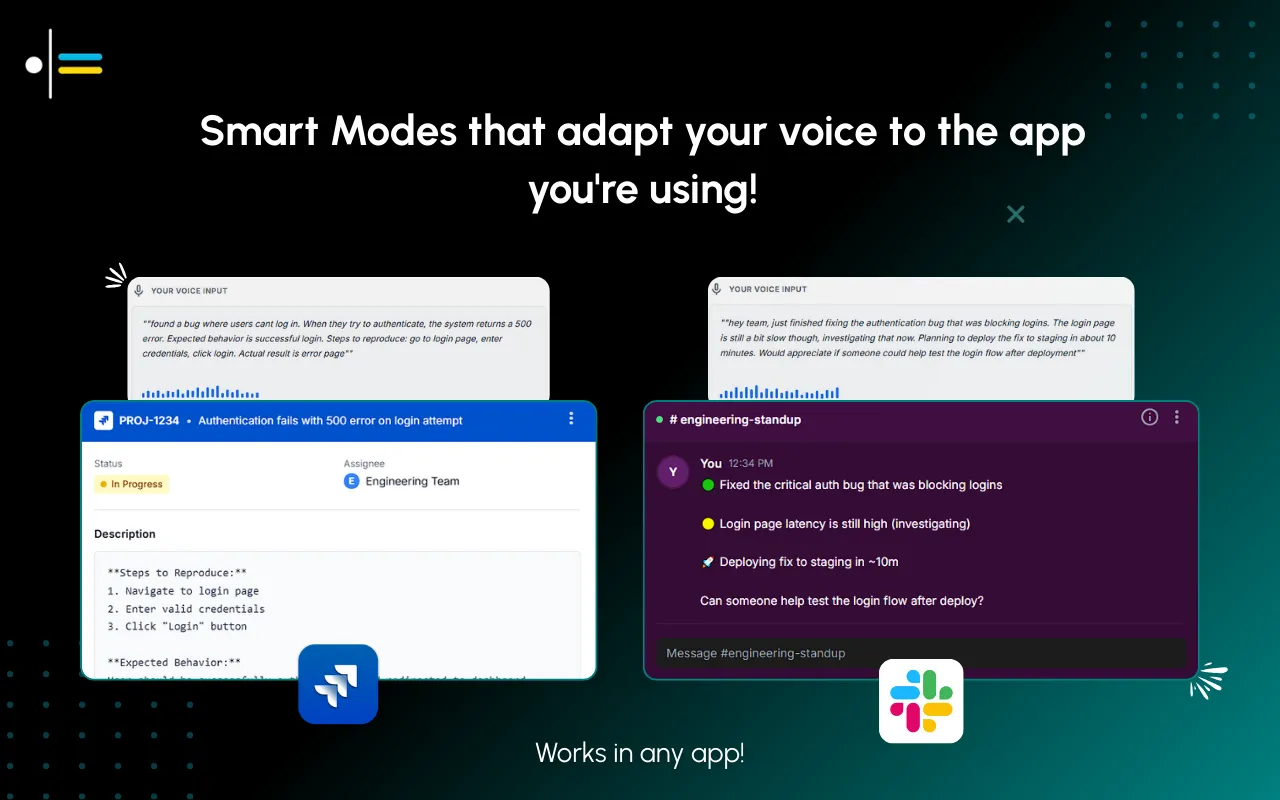
The Mode matters. In Notes Mode, Contextli writes what you say as a clean, readable log entry rather than a formal paragraph, so your journal reads like notes and not like an email.
You can also make the tool match how you write. Feed a Mode three or four examples of your own log style, or an instruction like "keep entries short and use first person," and every dictation after that follows that voice. That is the customization story: you are not adapting to the tool, it adapts to you. There is a guide on customizing Contextli modes with examples if you want to set that up.
A quick word on scope
Contextli is a writing tool, not a treatment program and not a substitute for professional support. It may support the habit of keeping a record; it does not replace a counselor, a sponsor, or a clinician, and it makes no claim about recovery outcomes. If you are struggling, reach out to a professional or a support line. A sobriety app is a memory aid, and that is a genuinely useful thing, but it is only that.

FAQ
What is a sobriety app?
It is a tool that helps you track time sober and, in the better cases, record the context around cravings, triggers, and wins. Some are pure day counters; others add a journaling layer so you can see patterns over time.
Do I need both a counter and a journal?
Often, yes. A counter keeps you motivated with a running number, and a journal captures the "why" behind hard and good days. They answer different questions, so many people in recovery use one of each.
Can I keep my recovery notes fully private?
Yes. With Contextli you can run transcription and processing locally, use your own API key so data goes straight to your provider, or turn cloud sync off so notes stay as local files. Stack all three and nothing leaves your machine.
Is voice dictation really faster than typing a journal entry?
For a reflective entry, usually. A note that takes around 90 seconds to type takes roughly 25 seconds to say, and speaking is easier than typing when you are stressed or shaky.
Does Contextli work with my existing notes app?
It types your spoken words into whatever window is focused, so it works with the notes app or plain text file you already use. It has no built-in integration with specific journaling services; it is a system-level tool that types into the app you have open.
Can I make the log entries sound like me?
Yes. Give a Mode three or four examples of how you write, or a short instruction, and Contextli matches that style on every dictation after that.
Is Contextli a substitute for treatment or a support group?
No. It is a writing and note-taking tool that may support the habit of keeping a record. It does not replace professional care, a sponsor, or a support group.
How much does it cost to try?
The free tier is 100 credits/month on the free tier, no credit card required, which is enough to test whether dictating your sobriety log fits how you work.
If you are building a tracking habit, these are worth a look: keeping a mood tracker alongside your sobriety log, mood tracking for anxiety when triggers are emotional, a gratitude journal habit to balance the record, and a brain dump approach for the days your thoughts move faster than your hands. This article sits in the wider Contextli contexts library.
Try dictating your next entry
If typing is what keeps you from logging the moments that matter, speak them instead. Contextli types your spoken sobriety log straight into your own notes file, and you can keep it fully offline with local models and cloud sync off. Start with the free tier: 100 credits/month on the free tier, no credit card required. See how Contextli works.



 Junaid Khalid