

Software Bug ReportJul 28, 2026
Bug Report Template: Tickets Developers Understand
A bug report template with repro steps, environment, and expected versus actual behavior. Copy the seven fields and cut the back-and-forth.
 Junaid Khalid
A brain dump template you can run in 10 minutes flat. Copy the prompts, sort the mess into next actions, and try dictating it instead of typing.
Your head is loud. There are 14 half-formed tasks, two worries about a client, a reminder to book the dentist, and a vague sense that you forgot something important. You sit down to work and your attention keeps snagging on the noise. A brain dump fixes this, but most people either skip it because a blank page feels like a chore, or they dump everything out and then leave it as an unread mess. This is a brain dump template you can run in 10 minutes: a fixed set of prompts to empty your head, plus a short sort step so the output turns into next actions instead of another pile.
A brain dump is the act of writing down every open loop in your head, unsorted, until nothing is left rattling around. The point is not to organize as you go. The point is to get everything out of working memory and onto a page so your brain stops rehearsing it.
A brain dump template adds structure to that. Instead of staring at a blank page, you answer a fixed list of prompts. The prompts do the remembering for you: they poke at the corners of your head where forgotten tasks hide (the errand, the reply you owe, the thing you promised a colleague). That is the difference between a mind dump template and freewriting. Freewriting wanders. A template covers the whole surface in a set time.
This is close to what morning pages or a daily journal do, but narrower and faster. Morning pages are three longhand pages of whatever comes; a brain dump worksheet is targeted to close open loops, not to reflect. You can do both, but they solve different problems.
Copy these seven prompts into a note file, a doc, or a sheet of paper. Set a timer for 6 minutes. Answer each one in fragments, not full sentences. Do not edit. Do not sort yet.
When the timer ends, stop dumping. Set a second timer for 4 minutes and sort every line into one of three buckets:
That sort is the step most people skip, and it is why their thought dump exercise never seems to help. A dump without a sort just relocates the noise. The sort is what makes your head quieter afterward, because every item now has a home.
Typing a brain dump has a hidden tax. You think of something, start typing, notice a typo, fix it, lose the thread, and the next three thoughts evaporate while you were correcting a comma. The whole point of a dump is speed, and typing keeps interrupting the speed.
Speaking does not have that tax. You talk faster than you type, and more importantly you do not stop to fix anything, because you are not looking at the words. A spoken brain dump tends to be longer and more honest than a typed one, because you are not editing yourself into a tidy version.
The catch has always been that raw dictation gives you a wall of run-on text with no punctuation and every "um" left in. That is where a context-aware dictation tool matters. Contextli runs on your desktop and types into whatever window is focused, so you speak your dump and it lands as clean, punctuated text in your note file. In Notes Mode it keeps your fragments as fragments instead of forcing them into prose, which is what a dump wants.
A brain dump is not about writing well. It is about getting everything out before your brain talks you out of it.
You can also feed a Mode 3 to 4 examples of how you like your notes to look (short lines, no capitalization, dashes for tasks) and every dictation after that matches that style. So the dump comes out already in your format, not a generic paragraph you then have to reshape.
Here is how the two approaches compare on the things that actually decide whether you keep doing a brain dump.
| Factor | Typed brain dump | Spoken brain dump (Contextli, Notes Mode) |
|---|---|---|
| Time to empty a full head | 12 to 15 minutes | 6 to 8 minutes |
| Mid-thought interruptions | High (you fix as you type) | Low (you never look at the text) |
| Output format | Whatever you typed | Cleaned, punctuated, matches your example style |
| Where it lands | The note you typed into | Types into the focused window, system-level |
| Editing needed after | Some | Little, if you set up examples |
| Works with internet off | Yes | Yes, with the local model turned on |
The comparison is not "dictation wins at everything." If you prefer the physical act of writing longhand, keep doing that. Speaking wins specifically on speed and on not interrupting your own train of thought, which is what a dump is for.
A brain dump is one of the most personal things you will write. It contains worries, half-formed opinions about people, and things you are avoiding. You should think about where that text goes before you speak it into any tool.
Contextli gives you three privacy levels you can stack:
Stack all three and your brain dump is fully offline and fully private. That is a combination worth having when the thing you are writing is a raw picture of your own head. For the full breakdown, see the dictation privacy guide and the bring-your-own-key setup.
A template only helps if it survives contact with an actual schedule. Two short scenarios, both using the 10-minute template above.
A freelance consultant opens her laptop at 8:40am with a client call at 9. Her head is full of the call plus four unrelated open loops. She starts Contextli in Notes Mode and speaks through the seven prompts. Typing this dump usually takes her about 12 minutes; speaking it takes about 5. She spends the remaining 4 minutes sorting: two items to Do, three to Defer with dates, one worry named and dropped. She walks into the call with a clear head at 8:59.
A founder does his dump at the end of the day instead. Tired and not wanting to type, he speaks the prompts into his running task file at the kitchen counter. The Marketing Copy Mode and Email Mode he uses for work stay untouched; this is just Notes Mode dumping fragments. Because he set up an example note earlier, every line comes out as a dash-prefixed task in his format. He closes the laptop without carrying the day's open loops into the evening.
The first brain dump feels great and then most people never do a second one. The trick is to attach it to something you already do daily, so it does not need its own willpower.
Pick a fixed trigger: the first coffee, the moment you sit down, the last thing before you close the laptop. Run the same seven prompts every time and keep the template pinned in your note app so there is zero setup friction. Spoken, the whole thing including the sort is under 10 minutes, short enough to keep even on a bad day.
If you want more structure around specific kinds of capture, the ADHD productivity templates and dictation templates for ADHD go deeper on prompt sets, and the 7 ways to write faster without typing piece covers where dictation fits across a workday beyond the dump.

About 10 minutes total: 6 minutes to empty your head against the prompts, 4 minutes to sort into Do, Defer, and Drop. If it runs long, you are editing instead of dumping. Set a timer and stop when it rings.
A brain dump targets open loops and next actions, and it is fast. Brain dump journaling and morning pages are broader and more reflective. A dump asks "what is unfinished in my head." A journal asks "how am I doing." You can do both; they are not the same tool.
No. The seven-prompt template works on paper or in any note file. An app helps if you speak the dump instead of typing it, because a dictation tool cleans up the run-on text and drops it into your note. The template itself is free to copy and reuse.
Usually, yes. Most people speak two to three times faster than they type, and a spoken dump avoids the stop-and-fix loop that typing creates. In practice a full dump that takes 12 minutes to type takes about 5 to 6 minutes to speak.
Yes. With Contextli you can run the local model with the internet off, use your own provider API key, and disable cloud sync so notes stay as local files. Stack all three and the dump never leaves your machine. See the dictation privacy guide for the full setup.
Contextli types into whatever window is focused, system-level. It has no direct Notion, Evernote, or Obsidian integration. You open your note file or doc, put your cursor where you want the text, speak, and the cleaned text is typed in there.
Sort every line into Do (a next action under an hour), Defer (real but later, with a date), or Drop (a worry with no action, which you name and release). The sort is what makes your head quieter. A dump without a sort just moves the noise around.
Daily works best for keeping open loops from piling up. Attach it to an existing habit like your first coffee or your end-of-day shutdown so it does not need its own motivation. A weekly longer dump can supplement the daily one.
The template above works today on paper. If the typing tax is what keeps stopping you, speak your next brain dump instead: open your note file, start Contextli in Notes Mode, and run the seven prompts. You get clean, punctuated fragments typed straight into your note, in the format you set up, in about half the time. The free tier is 100 credits per month, no credit card required, so you can test a spoken dump this week and keep the ones that stick.
Download Contextli and dictate your first brain dump into your own note file. For more capture templates across the library, start at the Contexts hub.

Junaid Khalid
Founder & CEO
Founder and solopreneur writing about how modern businesses run leaner and faster with AI. I build software that turns everyday work, from capturing thoughts to writing and staying organized, into something effortless, and I share what I learn along the way.
A bug report template with repro steps, environment, and expected versus actual behavior. Copy the seven fields and cut the back-and-forth.
Junaid Khalid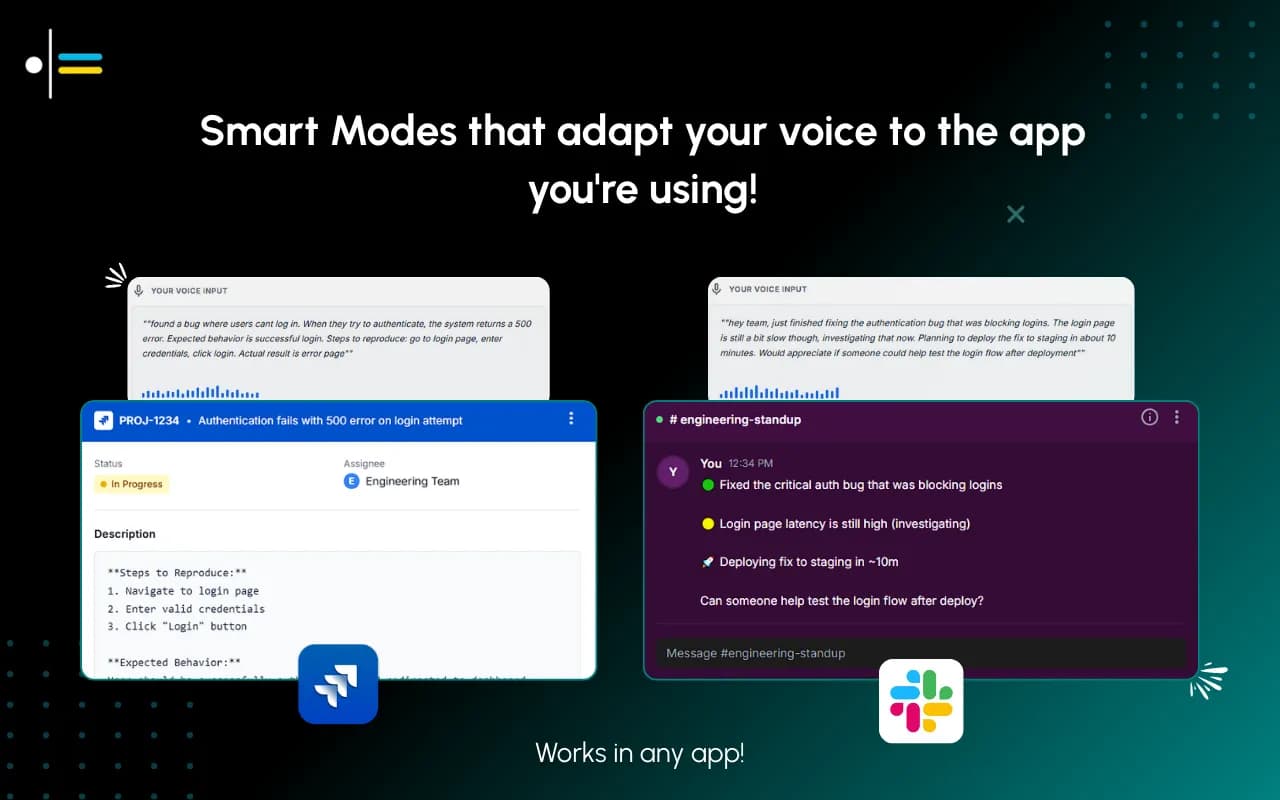
A calm monthly budget review for couples: one shared template, five prompts, and a voice-log method so money talks stop turning into arguments.
Junaid KhalidA blood pressure log app only helps if your doctor can read it. How to log BP by voice, add context, and hand over notes that make the visit faster.
Junaid Khalid