

Home Maintenance TrackerAug 4, 2026
Home Maintenance Log: Track Every Repair Before Warranty Ends
Build a home maintenance log that captures every repair, part, and warranty date by voice so nothing slips before coverage ends.
 Junaid Khalid
A field-tested checklist of what to put in a construction daily log, plus a faster way for site supervisors to capture it by voice on the job.

You finish a 10-hour shift, and the last thing between you and the truck is the daily log. So you type it from memory at 5:45pm: weather was "fine," the pour happened "in the morning," the late delivery becomes "delivery arrived." Three weeks later a delay claim lands on that day, and your log cannot say when the truck arrived, who was there, or why the pour slipped two hours. The record existed. It just did not hold the details that mattered.
A construction daily log is only worth writing if it captures what a dispute, an inspector, or a project manager will ask about later. Most do not, because the person best placed to record the day, the site supervisor, has the least time to type it. This guide covers what to record, and a way to capture it while it is still fresh.
A daily construction report is the contemporaneous record, meaning it was written at the time, that a court, an insurer, or a client will trust over anyone's later recollection. When a schedule slips or a payment is disputed, the daily log is the first document everyone reads. It fixes facts to dates and builds the paper trail behind change orders and claims for extra time or cost.
But a log only does that job if the entries are specific. "Rain delayed work" is a note. "Rain from 07:15 to 11:40 halted the east-side slab pour, crew of 6 stood down, resumed 12:10" is evidence. That gap is the entire value of the log, and it is what gets lost when you write from memory hours later.
Here is the core set. If your log holds these eight, it will answer almost any question asked of it later.
Keep the same field order every day. A consistent job site diary is faster to scan and far harder to poke holes in.
The problem is not that supervisors do not know what to record. It is that the recording happens at the wrong time. By the end of a shift, the 09:20 delivery has merged with the 14:00 one, the inspector's name is gone, and "about two hours" replaces "07:15 to 11:40." Memory decays fastest for the fields that matter most in a dispute: precise times, exact quantities, and names of people present.
The fix is to record at the moment, not at the end. The trouble is that stopping to type on a phone with gloves on, in the wind, standing in a trench, is slow enough that most people just do not do it.
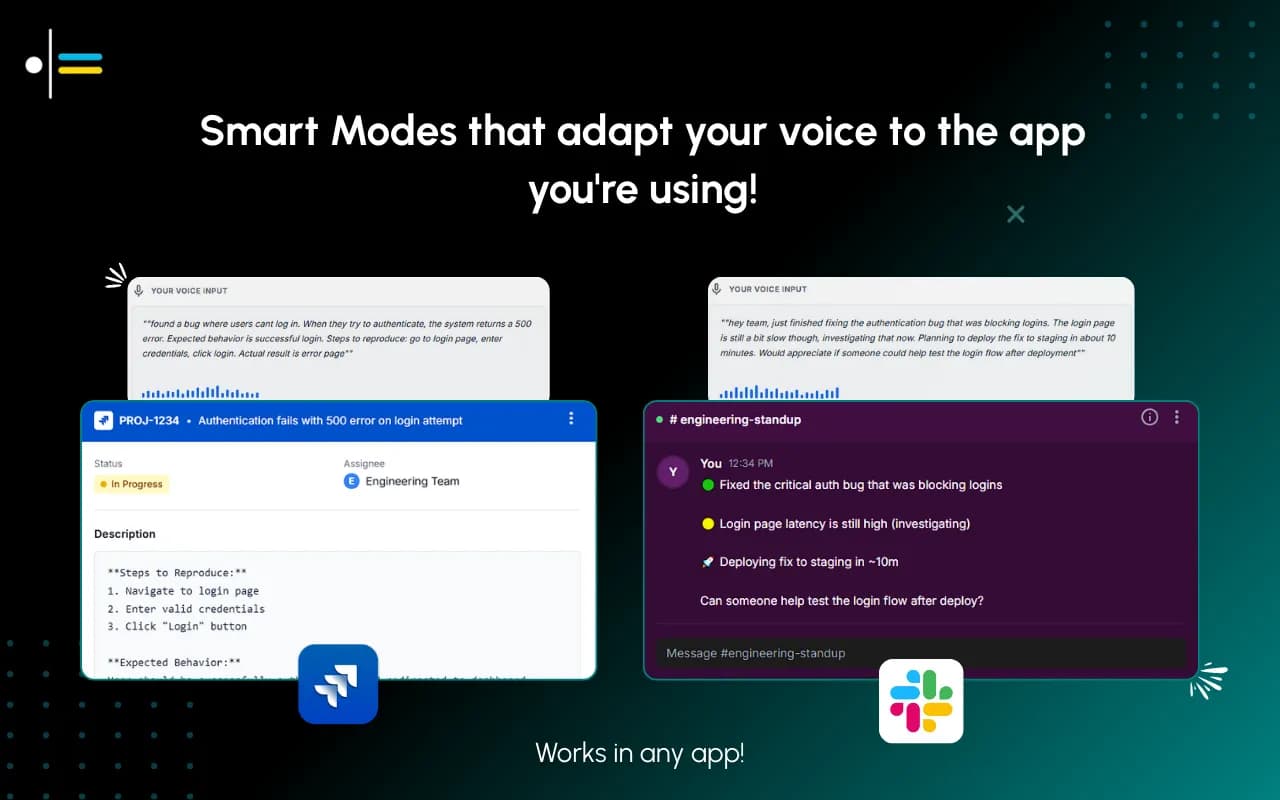
Voice fits site recording because you can talk while your hands and eyes stay on the work. But raw voice-to-text writes exactly what you say, filler and all, so you still spend time cleaning it up. That is the gap Contextli's Notes Mode closes: you give it a few examples of how your logs should read, and it shapes each dictation to match instead of dumping a wall of unpunctuated text. Here is how the three common methods compare for a supervisor's daily log.
| Method | Time to log one event on site | Detail retained | Cleanup needed | Works with no signal |
|---|---|---|---|---|
| Typing on phone (gloves, wind) | 60 to 90 seconds | Low, so you skip most events | None, but sparse | Yes |
| End-of-day typing from memory | 15 to 25 min for whole day | Low, times and names blur | None | Yes |
| Contextli Notes Mode, dictated on site | ~20 seconds per event | High, captured while fresh | Minimal, Mode formats it | Yes, with local models |
The point is not that dictation is faster to type. It is the only method fast enough that you actually record each event when it happens, which is when the detail still exists.
Contextli is a desktop speech-to-text app that types into whatever window is focused. It has no special construction integration and needs none: your log lives in the same spreadsheet, project-management field, or document you already use, and Contextli types straight into it. There is no new logging app for your crew leads to learn. Two things make it suit a job site specifically.
First, the customization. You feed Notes Mode 3 or 4 examples of a well-formed log entry, including your field order and shorthand, and every dictation after that follows the pattern. Say "sign off entries with my initials, JK, not my full name" and it does. The log reads like your log, not like a transcript.
Second, the privacy stack, which matters more on construction work than people expect. Site logs carry contract terms, incident details, and personnel names you do not want on someone else's server. Contextli gives three stackable levels of control: run transcription and processing with local models on your laptop, internet off, and it still works; bring your own API key so audio and text go straight from your machine to the provider, with Contextli never seeing them; and disable cloud sync so notes live as local files, not in any Contextli database. Stack all three and a log dictated in a basement with no signal never leaves the machine in your hand.
Honest trade-off: the fully local models want a reasonably modern Mac or Windows laptop; on an older machine they run slowly, and the bring-your-own-key route may suit you better. And if all you need is plain transcription, a faster tool like Wispr Flow will out-run it on raw speed. Contextli's edge is shaping the words and keeping them private, not winning a stopwatch race.
A site supervisor is overseeing a slab pour on the east side. At 07:15 the rain starts. He taps his dictation shortcut on the laptop in the site cabin and says: "Rain started 07:15, east slab pour halted, crew of six stood down." Notes Mode types a clean, dated entry into his daily-log spreadsheet in about 20 seconds, and he is back outside before the next gust.
At 11:40 he dictates the resume time. At 14:05 a rebar delivery arrives two hours late, and he dictates the supplier, quantity, and exact time on the spot. By day's end his log holds four timestamped entries he never had to reconstruct. Three weeks later, when the supplier disputes that late delivery, the 14:05 entry settles it in one line.
A log is only as good as the discipline behind it. Four rules keep it defensible.
Record contemporaneously. Enter each event when it happens, not in one end-of-day block. This is the single habit that separates a note from evidence.
Quantify. Every entry that can carry a number, times, headcounts, quantities, should carry one. "Some delay" helps no one; "delayed 4 hours 25 minutes" does.
Never leave gaps or backfill. An empty day looks like a missing day, so if nothing notable happened, write that. Do not rewrite old entries; add a correction with today's date.
Keep the field order identical every day. Predictable structure is faster to write, faster to read, and harder to challenge.

Eight fields: date and weather, crew and headcount, work completed by location, equipment on site, deliveries with timestamps, delays with causes, safety and inspection notes, and instructions given or received.
They are usually the same document. "Daily log" or "job site diary" is the supervisor's raw field record; "daily construction report" is the tidied-up version shared with the client or head office.
A log written at the time is treated as a contemporaneous record, which carries far more weight than anyone's later memory. When a delay claim arises, the daily log is the first document read, and specific, timestamped entries are what win or lose it.
Yes, and on site it is usually the better option because you can talk while your hands stay on the work. Contextli's Notes Mode types your spoken entry into your existing log document and formats it to match examples you provide, so you skip cleaning up raw transcription.
Only if you let it. Contextli can run transcription and processing with local models on your laptop with the internet off, and you can disable cloud sync so notes stay as local files. That keeps contract terms and names off any external server. Confirm your firm's data policy before recording anything sensitive.
Record each event the moment it happens rather than reconstructing the whole day at 5pm. Dictating a short entry per event takes roughly 20 seconds and captures the times and names that memory loses.
The same capture-at-the-moment habit shows up across other records: meeting notes, a repeatable note-taking workflow, expense tracking, a good brain-dump capture app, and why founders lean on voice for records they cannot afford to lose. All are context guides in the wider Contextli context library.
Want your daily log written in your own format, dictated on site, and kept on your own machine? Try Contextli's Notes Mode: speak each event as it happens and it types a clean, dated entry into your existing log. You get 100 credits/month on the free tier, no credit card required. See how the modes work at contextli.com/features.

Junaid Khalid
Founder & CEO
Founder and solopreneur writing about how modern businesses run leaner and faster with AI. I build software that turns everyday work, from capturing thoughts to writing and staying organized, into something effortless, and I share what I learn along the way.
Build a home maintenance log that captures every repair, part, and warranty date by voice so nothing slips before coverage ends.
Junaid KhalidA habit tracker app that survives your worst week: how to log by voice in seconds, recover broken streaks, and keep a private daily record.
Junaid Khalid
Build a gratitude journal for kids that actually sticks. A calm 3-minute nightly routine, prompts by age, and a hands-free way to capture their words.
Junaid Khalid