

Home Maintenance TrackerAug 4, 2026
Home Maintenance Log: Track Every Repair Before Warranty Ends
Build a home maintenance log that captures every repair, part, and warranty date by voice so nothing slips before coverage ends.
 Junaid Khalid
A coaching session notes template for life and executive coaches, plus a voice-to-notes method that captures client progress without losing the thread.
You finish a 60-minute session and have four minutes before the next client starts. This one mentioned a promotion decision, a conflict with their board chair, and a commitment from last week they did not keep. You scribble three half-words on a legal pad. By Thursday, when you prep the follow-up, none of it means anything. You cannot remember whether the board conflict caused the missed commitment or was a separate thread.
That gap between what happened in the room and what you can reconstruct later is where coaching relationships quietly lose momentum. A coaching session notes template fixes the structure problem. It does not fix the capture problem: you are a coach, not a stenographer, and the seconds after a session are the worst possible time to type.
Templates fail when they ask for too much. A coach filling out a 12-field form after every session abandons it inside a month. The version that survives is short enough to complete in under two minutes and specific enough to prep from later.
Five fields carry the load:
Presenting focus. What the client brought to the session, in their words. Not your reframe, their opening. This is the thread you check against next time.
Insight or shift. The moment something moved. A realization, a change in how they described the problem, a decision that surfaced. If nothing shifted, that is data too.
Commitments. What the client agreed to do before the next session, with a date. This is the single most reviewed field in any coaching log, so it earns its own line.
Coach observations. Private notes to yourself: patterns you noticed, a hypothesis to test, a question you held back. These stay out of any recap you share.
Follow-up thread. The one sentence you will read first next session. "Ask whether the board conversation happened."
The International Coaching Federation expects members to maintain client records and confidentiality, though it does not prescribe a format. Confirm your own certifying body's record-keeping requirements before you adopt any template. The five fields above are a working starting point, not a compliance standard.
You have the structure. You still lose the thread. Why?
Typing is the bottleneck. The average person types around 40 words per minute and speaks around 150. When you have four minutes between clients and a full session to reconstruct, a keyboard forces you to compress five fields into fragments. Fragments are what you cannot decode on Thursday.
The alternative is to talk your note out loud. Speaking a 90-word recap takes about 40 seconds. Typing the same 90 words takes over two minutes, and that is before you fix typos or format the fields. The spoken recap is longer, closer to what actually happened, and done before the next client knocks.
The catch with ordinary dictation is that it transcribes literally. You say "um, so the presenting focus was, like, the promotion thing" and that is exactly what lands in your note. Now you are editing, which puts the keyboard back in your hands.
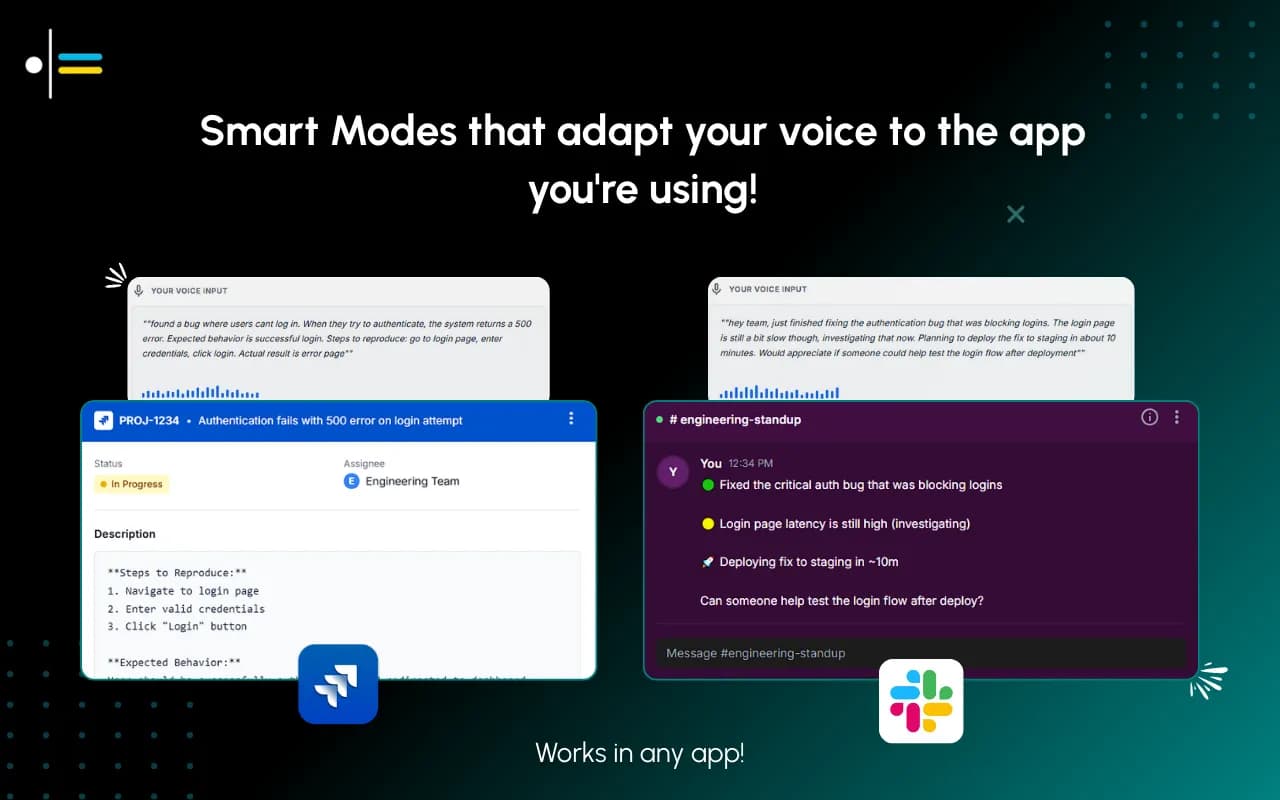
This is the difference between transcription and writing. Contextli is a context-aware speech-to-text desktop app, and its Notes Mode does not just type what you say word for word. You teach it your recap format by feeding it three or four examples of how you actually write session notes, and every dictation after that comes out in that shape.
The customization flow is direct. You paste two or three of your past notes into the Notes Mode context, or write a short instruction like "structure every note under Presenting focus, Insight, Commitments, Observations, Follow-up, drop filler words, keep it in third person." From then on, you speak a loose recap and Contextli returns it in your five-field structure, filler removed.
Contextli is a system-level app: it types into whatever window has focus. It has no integration with any specific notes tool, so it works the same whether your coaching log lives in a plain text file, a Google Doc, Notion, or a dedicated coaching log app. Put your cursor where the note goes and speak.
The table below compares the two ways a coach captures a session note, using the same 90-word recap in both cases.
| Approach | Time to a usable note | Comes out structured? | Filler removed? | Hands free for the next thing? |
|---|---|---|---|---|
| Typing into your template | ~2 min 15 sec | Only if you format as you go | No, you type what you think | No |
| Native macOS or Windows dictation | ~50 sec to transcribe, then edit | No | No | Partly |
| Contextli Notes Mode (taught your format) | ~45 sec, no edit pass | Yes, in your five fields | Yes | Yes |
Native dictation on Mac and Windows is genuinely useful and free, and if all you want is a raw transcript, it does the job. The reason it does not close the four-minute gap is that it hands you a literal transcript you still have to shape into your template. The shaping is the work. Contextli does the shaping because you told it your format once.
Coaching notes are sensitive. Executive clients discuss board conflicts, compensation, and decisions that are not public. Where those notes are processed matters.
Contextli gives you a privacy stack you can set to your comfort level. The strongest setting: run the local models, so both transcription and the AI processing happen on your own machine with the internet off, and the app still works. Nothing about the session leaves your laptop. The honest trade-off is that local models want a reasonably modern Mac or Windows machine; an old laptop will be slow.
If you prefer a cloud model for quality, bring your own API key (BYOK). Your audio and text go from your machine straight to the provider you chose, and Contextli never sees them. You can also disable cloud sync, in which case Contextli stores nothing in its database and your notes live as local files. Confirm your own practice's data-handling policy and your certifying body's confidentiality rules before deciding which setting fits.
Speak the recap while the session is fresh. Read one sentence to open the next. The thread survives the week.
An executive coach finishes a session at 2:00 and has a 2:05 start. The client spent the hour circling a decision to confront their CFO about a budget the coach suspects is a proxy for a trust issue.
Typing this into a five-field template properly takes about two and a half minutes: the coach never finishes before the next client joins, so they type two fragments and lose the rest. With Contextli in Notes Mode, taught the coach's own recap format, they speak for 45 seconds: "Presenting focus, the CFO budget confrontation, but it read like a trust issue underneath. Insight, they avoid direct conflict with peers, not reports. Commitment, draft the CFO message by Friday. Observation, test the trust hypothesis next time. Follow-up, ask if the message went out."
Contextli types that into the coaching log as five clean fields, filler gone, in third person. The coach clicks into the 2:05 session with the note already saved. On Thursday, the follow-up line reads first and the thread is intact.
The habit that makes any coaching log work is the recap immediately after the session, not batched at day's end. Batching is where detail dies. A 45-second spoken recap between clients is short enough to actually happen every time, which is the only thing that keeps a log complete. The point is not the template on its own. It is closing the gap between the room and the record while the session is still in your head.

Five fields cover most coaching contexts: presenting focus (what the client brought), insight or shift (what moved), commitments (what they agreed to do, with a date), coach observations (your private patterns and hypotheses), and the follow-up thread (the one line you read first next session). Keep it to five so you actually complete it.
Speak the recap instead of typing it. You talk at roughly 150 words per minute and type at around 40, so a spoken 90-word recap lands in about 45 seconds versus over two minutes typed. With Contextli's Notes Mode taught your format, the spoken recap comes out already structured, so there is no edit pass.
No. Contextli is a system-level speech-to-text desktop app that types into whatever window has focus. It has no integration with any specific coaching or notes tool, so it works with a plain text file, a Google Doc, Notion, or any coaching log app you already use.
Yes. Contextli can run local models so transcription and processing happen entirely on your machine with the internet off. You can also bring your own API key so data goes straight to your chosen provider, or disable cloud sync so notes stay as local files and nothing is stored in Contextli's database.
The ICF expects members to keep client records and maintain confidentiality but does not mandate a specific note format, so the five-field template is a practical structure, not a compliance guarantee. Confirm the current record-keeping and data policies for your own certifying body and jurisdiction.
Native dictation transcribes speech literally, so you get a raw transcript with filler words that you still have to shape into your template. Contextli's Notes Mode is taught your recap format by example, so the same spoken recap comes back structured into your fields with filler removed.
Contextli's free tier includes 100 credits/month on the free tier, no credit card required, which is enough to test whether a spoken recap between sessions holds your thread together across a coaching week.
If you are building a note habit across your practice, these help: a broader meeting notes template for capturing action items, a look at meeting note-taking apps that sync with your calendar, and, for setting and tracking client aims, a gratitude journal habit that shows how short daily entries compound.
To set up the dictation side, see how to customize Contextli Modes with your own examples and, if you run your own practice, voice to text for founders. The full library of context templates lives on the contexts pillar.
Teach Contextli your five-field recap format once, then speak your next session note in about 45 seconds and watch it land structured, in the coaching log you already use. Start with 100 credits/month on the free tier, no credit card required, and see whether the thread holds across a full week of clients. Download Contextli and set up your Notes Mode before your next session.

Junaid Khalid
Founder & CEO
Founder and solopreneur writing about how modern businesses run leaner and faster with AI. I build software that turns everyday work, from capturing thoughts to writing and staying organized, into something effortless, and I share what I learn along the way.
Build a home maintenance log that captures every repair, part, and warranty date by voice so nothing slips before coverage ends.
Junaid Khalid
A habit tracker app that survives your worst week: how to log by voice in seconds, recover broken streaks, and keep a private daily record.
Junaid Khalid
Build a gratitude journal for kids that actually sticks. A calm 3-minute nightly routine, prompts by age, and a hands-free way to capture their words.
Junaid Khalid