

Home Maintenance TrackerAug 4, 2026
Home Maintenance Log: Track Every Repair Before Warranty Ends
Build a home maintenance log that captures every repair, part, and warranty date by voice so nothing slips before coverage ends.
 Junaid Khalid
A decision journal app records why you chose, not just what. Compare tools, see a decision log template, and capture rationale by voice in seconds.
You made the call three months ago. Now the same question is back on the table, and you cannot remember why you decided the way you did the first time. So you re-argue it from scratch, with the same people, reaching a slightly different answer for reasons you will also forget. A decision journal app exists to end that loop: it records the reasoning behind a choice at the moment you make it, so the next time the topic returns you read your past self instead of guessing.
Most people already have the raw material. It lives in Slack threads, half-finished notes, and your own head. The problem is that none of it is written down as a decision, with the options you weighed and the reason you picked one. This guide covers what a decision journal app needs to do, how the common tools compare, a decision log template you can copy, and why speaking the rationale beats typing it when you are short on time.
A decision journal is a record of choices and the reasons behind them, kept over time. The point is not the decision itself, which you would have made anyway. The point is the reasoning, captured before you know how things turned out.
That last part matters. Once you know the result, your memory quietly rewrites the story. A coin-flip choice starts to feel obvious in hindsight, and a lucky guess starts to feel like skill. Writing the reasoning down at the time freezes it, so later you can compare what you believed against what happened.
For a working professional this pays off in three ways. You stop relitigating settled questions, because the answer and its reasoning are on record. You can hand a decision to someone else without a 20-minute meeting. And over a year you build a personal record of how you think, which is the raw material for getting better at it.
A decision log template does not need to be elaborate. Six fields cover almost everything, and anything past that tends to go unfilled.
| Field | What it holds | Why it matters |
|---|---|---|
| Date | When you decided | Anchors the decision before hindsight edits it |
| Decision | The choice in one line | Makes the entry searchable later |
| Options considered | What you rejected and why | Stops you re-proposing rejected options |
| The choice | What you actually picked | The outcome of the entry |
| Reasoning | Why this over the alternatives | The single most valuable field |
| Review date | When to check the result | Turns the log into a feedback loop |
The reasoning field is the one people skip and the one that carries all the value. "Went with vendor B" tells future-you nothing. "Went with vendor B despite the higher price because their support response time was 4 hours versus 2 days, and downtime costs us more than the price gap" is a decision rationale log entry you can actually use when the contract comes up for renewal.
The review date is the second thing people skip. Without it, a decision journal is a graveyard. With it, you get a scheduled prompt to compare what you predicted against what happened, which is the reason the log is worth keeping.
There is no single correct tool. The right decision tracking app is the one that fits where you already work, because a log you have to visit is a log you abandon. Here is how the common approaches compare on the axes that decide whether you keep using it.
| Tool type | Setup effort | Speed to log one decision | Searchable later | Best for |
|---|---|---|---|---|
| Plain notes app (Notes, Obsidian) | Low | Medium (you type) | Yes, if tagged | People who already live in notes |
| Spreadsheet | Low | Slow (cell by cell) | Yes, by column | Structured thinkers, many small decisions |
| Dedicated decision journal app | Medium | Medium | Yes | People who want prompts built in |
| Meeting notes doc | None | Fast in-meeting | Weak (buried) | Team decisions made live |
The column that predicts abandonment is "speed to log one decision." A decision journal only works if capturing an entry is nearly frictionless. If logging a choice means opening a tool, finding the right file, and typing six fields cleanly, you will do it for a week and then stop. The winning setup is whichever one lets you get the reasoning down in under a minute while it is still fresh.
That is also why a decision making journal often fails as a habit. The tool is fine. The friction of typing a paragraph of nuanced reasoning, at the exact moment you would rather move on, is what kills it.
Reasoning is messy in a way that typing punishes. When you talk through why you chose something, you say the real reason, including the hedge and the gut feeling. When you type it, you clean it up. The clean version reads better and helps you less, because the hedge you deleted is often the part that turns out to matter.
Speaking is also faster. A paragraph of honest rationale takes about 90 seconds to type carefully and about 20 seconds to say. Over a year of decisions that gap is the difference between a habit that sticks and one that quietly dies in February.
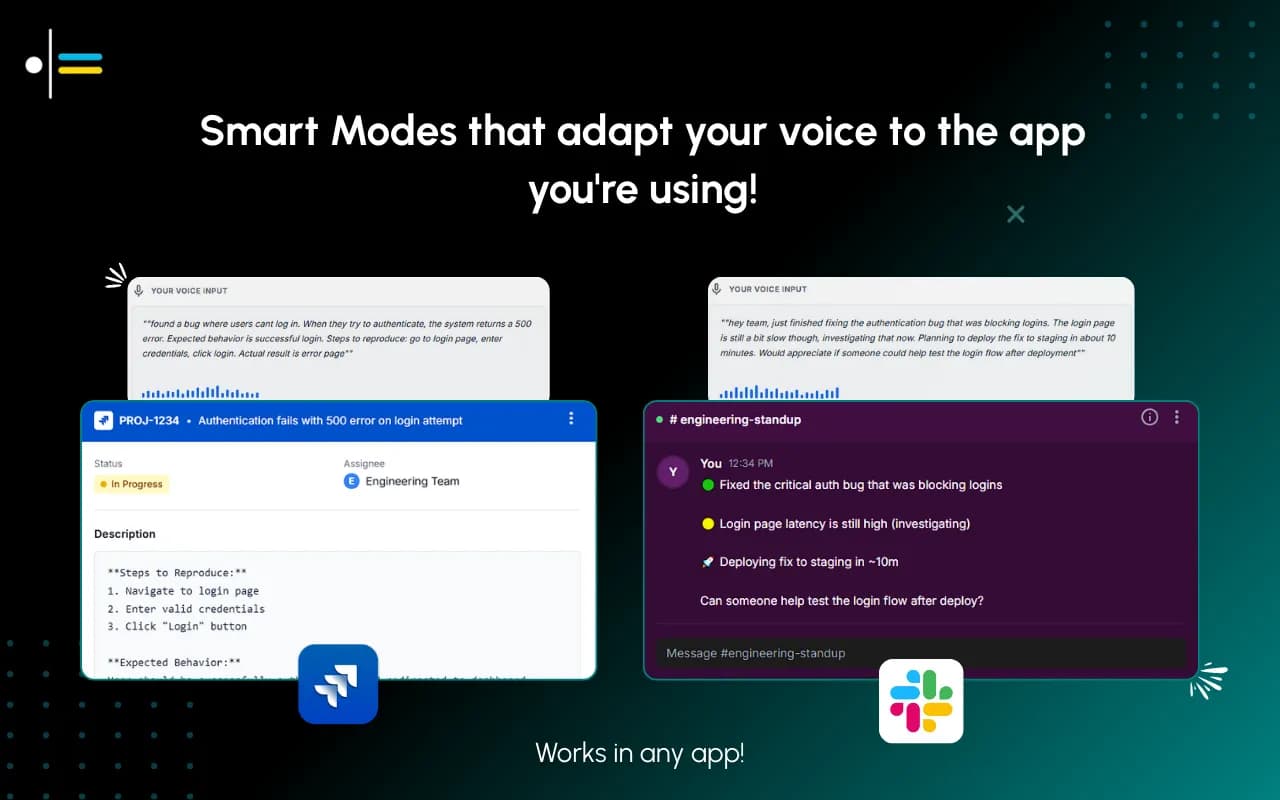
This is where a dictation tool fits into a decision journal workflow. Contextli is a desktop speech-to-text app that types into whatever window is focused, so it writes directly into your notes app, spreadsheet, or doc without any integration. You are not moving your log into a new tool. You are speaking into the log you already keep.
A decision you can read the reasoning for is a decision you never have to make twice.
The mode that fits here is Notes Mode, which keeps your phrasing close to how you actually said it rather than rewriting it into an email. And because reasoning has its own vocabulary, you can feed a context 3 or 4 examples of how you write decision entries, so terms like your project names, vendor names, and shorthand come out spelled the way you mean them every time. That is the customization flow: a few examples, then every dictation matches your voice.
Decision logs are sensitive by nature. They hold vendor negotiations, hiring calls, and reasoning you would not want in a third party's database. This is where the tool you dictate with matters more than the log format.
Contextli offers a privacy setup built in three stackable levels. First, local models: transcription and processing run on your own machine with the internet off, and the app still works, the honest trade-off being that you need a reasonably modern Mac or Windows laptop and older machines run slower. Second, bring your own API key: your text goes from your machine straight to the provider you chose, and Contextli never sees it. Third, disable cloud sync: turn it off and Contextli stores nothing in its database, so your notes live as local files on your disk. Stack all three and your decision rationale log never leaves your control. No competitor offers that combination.
If your decisions touch client or regulated data, confirm your own firm's data policy before logging specifics, and keep the sensitive detail in files you control rather than any synced database.
A hiring manager is about to extend an offer, then pauses. The candidate is strong, but there is a reservation she cannot quite name. She opens her decision log in her notes app, presses her Contextli shortcut, and speaks for 30 seconds in Notes Mode: the two finalists, why she is leaning toward the second one despite less experience, and the specific worry about the first candidate's answer on the ownership question. Typing that honestly would have taken about 2 minutes and she would have softened the worry. Speaking it took 25 seconds and she left the worry in.
Six weeks later the review date hits. She reads the entry. The reservation she almost talked herself out of was exactly the thing that showed up in the first month. Next time a similar answer comes up in an interview, she does not re-derive the lesson. She already wrote it down, in her own words, while it was true.

It is a tool for recording choices and the reasoning behind them over time. The purpose is to capture why you decided something at the moment you decided it, before hindsight rewrites your memory, so you can review the reasoning later and avoid re-deciding settled questions.
A plain notes app or spreadsheet is enough for most people. Dedicated tools add built-in prompts and review reminders, but the format matters less than the habit. The deciding factor is whether logging one decision takes under a minute, because friction kills the habit, not the tool.
Six fields: date, the decision in one line, options you considered, the choice you made, the reasoning, and a review date. The reasoning field carries the value, and the review date turns the log into a feedback loop instead of a graveyard of old notes.
Regular notes record what happened. A decision rationale log records why you chose one option over the others, written before you know the result. That timing is the whole point, because it freezes your actual thinking before the outcome distorts it.
Yes, and it is often faster and more honest than typing. Speaking a paragraph of reasoning takes about 20 seconds versus around 90 to type it carefully, and you tend to leave in the hedges and gut feelings that a typed version cleans away. Contextli types your spoken reasoning directly into whatever log you already use.
It depends on the dictation tool. Contextli offers a setup where transcription runs on your own machine with the internet off, you can use your own API key so text goes straight to your chosen provider, and you can disable cloud sync so nothing is stored in its database. Stacked together, your decision log stays on your device.
Set a review date per entry rather than a fixed schedule. A short-horizon choice might get a two-week review, a strategic one six months. The review is where you compare what you predicted against what happened, which is what improves your judgment.
A decision log is one kind of capture habit, and it pairs well with a few others. If decisions get made in meetings, a meeting notes template keeps the reasoning from getting buried in the transcript. When ideas arrive faster than you can sort them, a brain dump app that actually captures your thoughts gives them somewhere to land before you decide anything.
The same friction-first logic applies to money and to voice setup. See how it plays out for expense tracking for freelancers, how to teach a dictation tool your vocabulary in customizing Contextli modes with examples, and how to keep any dictated log private in the dictation privacy guide. For the wider set of capture habits Contextli supports, browse the Contexts library.
The next time you make a call you might question later, capture the reasoning before you move on. Contextli lets you speak the why in one breath and types it straight into the log you already keep, with a privacy setup where nothing has to leave your machine. You get 100 credits/month on the free tier, no credit card required, which is enough to log your first weeks of decisions by voice. Download Contextli and try it on the next choice you would rather not make twice.

Junaid Khalid
Founder & CEO
Founder and solopreneur writing about how modern businesses run leaner and faster with AI. I build software that turns everyday work, from capturing thoughts to writing and staying organized, into something effortless, and I share what I learn along the way.
Build a home maintenance log that captures every repair, part, and warranty date by voice so nothing slips before coverage ends.
Junaid Khalid
A habit tracker app that survives your worst week: how to log by voice in seconds, recover broken streaks, and keep a private daily record.
Junaid Khalid
Build a gratitude journal for kids that actually sticks. A calm 3-minute nightly routine, prompts by age, and a hands-free way to capture their words.
Junaid Khalid