

Home Maintenance TrackerAug 4, 2026
Home Maintenance Log: Track Every Repair Before Warranty Ends
Build a home maintenance log that captures every repair, part, and warranty date by voice so nothing slips before coverage ends.
 Junaid Khalid
A structured interview debrief template with scoring, evidence prompts, and a fast way to capture notes by voice so your hiring team stays aligned.
The worst hiring decisions rarely come from a bad interview. They come from a bad debrief. Four interviewers walk in with four different impressions, the loudest voice sets the tone, and within ten minutes the candidate is a yes or a no based on who spoke first. Nobody wrote down what actually happened, so the conversation runs on memory, and memory is exactly where bias lives. A written interview debrief template fixes the order of operations: every interviewer records evidence before the group talks, and the discussion works from notes instead of hunches.
This guide gives you a debrief structure you can reuse for every role, the fields that keep feedback tied to evidence, and a faster way to capture interviewer notes so the writing step does not get skipped when everyone is busy.
Unstructured debriefs reward confidence, not accuracy. The person who says "I just didn't get a good feeling" carries the same weight as the person who can quote the candidate's answer on a system-design question, so the group defaults to social dynamics: seniority, volume, and who is willing to argue.
A template forces three things a group chat never will. Every interviewer commits to a written position before hearing anyone else. Each rating attaches to a specific competency the role requires, not a vague impression. And the discussion starts from the disagreements, because the template makes them visible at a glance. The point is not to remove judgment; it is to make judgment name the moment it formed, so weak signals get filtered out.
Use the same skeleton for every candidate on a given role. Copy it once, fill it in per interviewer, and collect all copies before the debrief meeting.
1. Candidate and role header. Name, role, round, interviewer, date, and the specific area you were assigned to assess (for example: coding, system design, stakeholder management). Assigning areas up front stops four people from all probing the same thing.
2. Competency scores. Rate each of the 4 to 6 competencies the role scorecard defines on a 1 to 4 scale (1 = clear miss, 2 = below bar, 3 = meets bar, 4 = clearly above bar). A 4-point scale is deliberate: it removes the safe middle "3 out of 5" that lets people avoid a position.
3. Evidence per score. This field does the real work. Next to each score, write one or two lines of what the candidate said or did that justifies it: "Scored a 2 on system design: could not explain how the cache would invalidate, and did not ask about read/write ratio." No evidence, no score.
4. Overall recommendation. Strong hire, hire, no hire, strong no hire. One recommendation, no hedging.
5. Open questions for the next round. Anything you did not get to, or a risk the next interviewer should probe. This keeps the loop moving forward instead of re-litigating.
Here is how each field maps to the bias it guards against.
| Template field | What it captures | Bias it guards against |
|---|---|---|
| Assigned assessment area | The specific competency you owned | Overlap and groupthink from everyone probing the same skill |
| Competency score (1 to 4) | A number per required skill | Vague "good/bad" overall impressions |
| Evidence per score | The exact quote or moment | Confirmation bias and post-hoc storytelling |
| Overall recommendation | One clear position | Fence-sitting and consensus drift |
| Open questions | Gaps for the next round | Repeating the same interview twice |
The single most important rule: every interviewer submits their completed template before the group meets. Not during. Before.
Anchoring is well documented in hiring research: the first opinion voiced pulls every later rating toward it. If the hiring manager opens with "I loved this candidate," the room adjusts upward, and the interviewer who saw a real gap now second-guesses a note they never wrote. Independent submission breaks that chain. By the time anyone speaks, the positions are on paper and cannot be quietly revised to match the crowd. This only works if writing the notes is fast enough that people do it while the interview is fresh, not from fuzzy memory two days later.
The fastest moment to record honest feedback is the two minutes right after the candidate leaves the call, before the next meeting overwrites it. Typing loses that window: you are tired, the fields are long, and it is easier to tell yourself you will do it later.
Speaking is faster, and this is where a dictation tool matters. Contextli is a context-aware speech-to-text desktop app that types into whatever window you have focused, so you can dictate straight into your applicant tracking system, a shared doc, or a notes file. It has no direct integration with any specific hiring tool and does not need one: it works at the system level and types into the field your cursor is in.
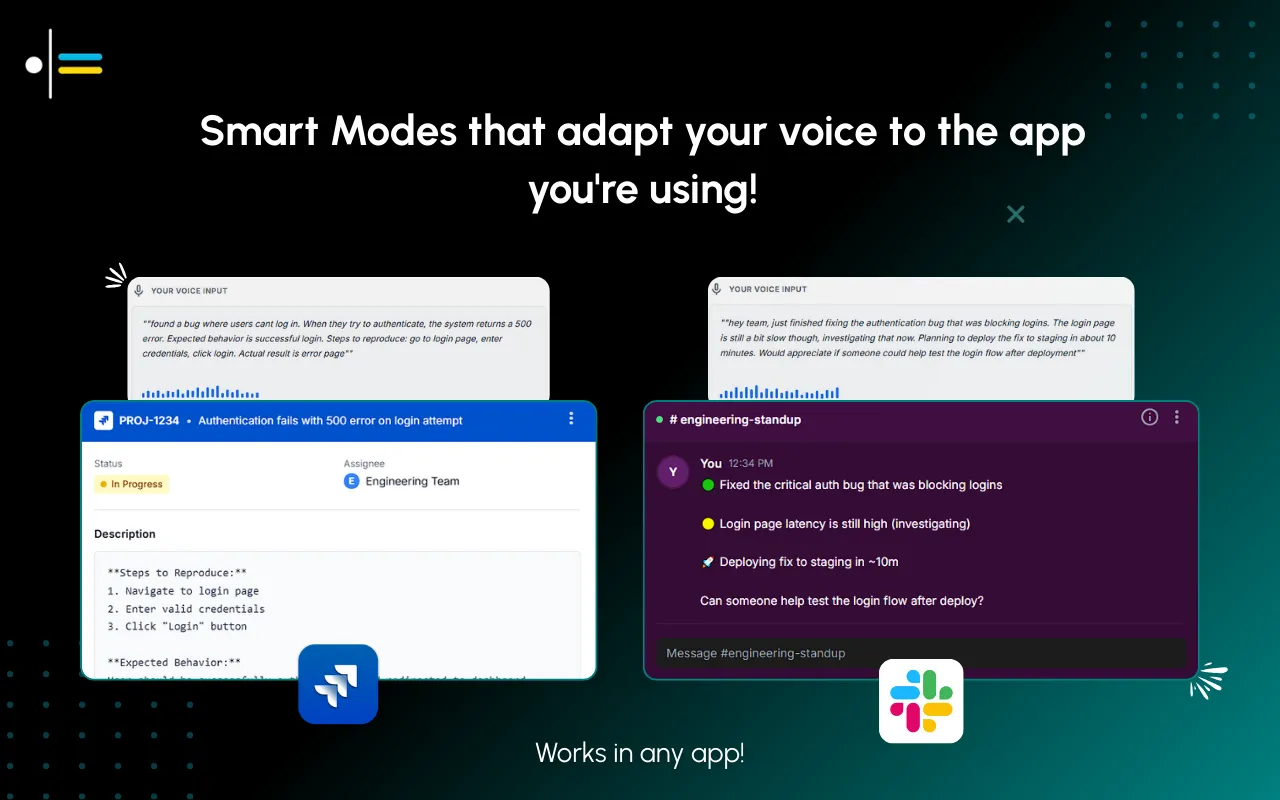
The relevant Mode here is Notes Mode. Instead of transcribing a rambling voice memo word for word, it writes structured notes: clean sentences, no filler, grouped the way you spoke them. You say "score two on system design, could not explain cache invalidation, did not ask about read write ratio, follow up next round on data modeling," and it types a tidy note rather than a run-on transcript.
You can also customize a Mode to your team's format. Feed it three or four examples of how your debrief notes should read (competency, score, one line of evidence) and every future dictation follows that shape. If your team writes "SCORE / EVIDENCE / RISK," it keeps to that. This is the customization-by-example flow: you teach the Mode your house style once, not edit every note by hand.
Wispr Flow is faster if all you need is raw transcription with no formatting opinion. Contextli's angle is different: it writes the note in the structure you asked for, which is what a debrief field needs.
Interview notes are sensitive. They contain names, judgments, and sometimes protected-characteristic-adjacent observations that should never leak, so where the text is processed matters as much as how it is written. Contextli gives you three privacy levels you can stack:
Stack all three and the whole flow is offline and private, a combination no other dictation tool offers. For a hiring team handling candidate records, that is the difference between a convenient tool and one your data policy will actually allow. Confirm your firm's data-handling rules before adopting any tool for candidate information.
A recruiting coordinator finishes a panel loop for a senior analyst role: four interviewers, four assigned areas. She used to chase everyone for two days to get written feedback, and half of it arrived after the group had informally decided.
Now, the moment each call ends, the interviewer opens their debrief note and speaks it. Using Notes Mode, one dictates: "SCORE 3 stakeholder management, walked through the pricing-pushback story clearly, named the two stakeholders and how she aligned them, RISK none, FOLLOW UP none." Typing that cleanly takes about 5 minutes at the end of a long day; speaking it takes roughly 90 seconds, and it lands formatted because the Mode was taught the SCORE / RISK / FOLLOW UP shape from three examples.
By the time the meeting starts an hour later, all four templates are in, written independently, with evidence attached. The coordinator opens on the one competency where scores split (a 2 and a 4 on analytical depth) instead of asking "so, what did everyone think." The meeting runs 15 minutes instead of 40, and the decision points at what the candidate said.

At minimum: a candidate and role header, 4 to 6 competency scores on a fixed scale, one line of evidence per score, a single overall recommendation, and open questions for the next round. The evidence field separates a useful template from a feelings survey.
Collect every interviewer's completed template before the meeting, then start the discussion on the competencies where scores disagree. Working from independently written notes stops the first speaker from anchoring the room.
A scorecard is usually the per-interviewer rating grid for one candidate. A debrief template is the wider structure the team uses to compare those scorecards and reach a decision. In practice they overlap; the debrief template adds the recommendation and next-round handoff.
Because unstructured debriefs run on memory and social dynamics. Whoever speaks first sets an anchor, confirmation bias fills the gaps, and impressions harden into stories. Independent written notes with attached evidence are the standard counter to all three.
Yes. A dictation app like Contextli types your spoken notes straight into your ATS or a shared doc. Its Notes Mode writes structured notes rather than a raw transcript, which is why it fits a debrief field. Speaking a note takes roughly 90 seconds versus 5 or more minutes of typing.
It can be, if the processing stays private. Contextli can run entirely on your own machine with the internet off, or send text to your own provider key, and store nothing in its database when you disable cloud sync. Confirm your firm's data policy before recording candidate information anywhere.
Fill in your debrief template the minute the interview ends, and dictate it so the evidence is still fresh. Contextli's Notes Mode types clean, structured feedback into your ATS or a shared doc, on-device if you keep candidate data off the cloud. Start free with 100 credits/month on the free tier, no credit card required, and see how fast a debrief note gets written when you speak it. Download Contextli.

Junaid Khalid
Founder & CEO
Founder and solopreneur writing about how modern businesses run leaner and faster with AI. I build software that turns everyday work, from capturing thoughts to writing and staying organized, into something effortless, and I share what I learn along the way.
Build a home maintenance log that captures every repair, part, and warranty date by voice so nothing slips before coverage ends.
Junaid Khalid
A habit tracker app that survives your worst week: how to log by voice in seconds, recover broken streaks, and keep a private daily record.
Junaid Khalid
Build a gratitude journal for kids that actually sticks. A calm 3-minute nightly routine, prompts by age, and a hands-free way to capture their words.
Junaid Khalid